THE MISSING CASTLE

In the twelfth century Ipswich had a motte-and-bailey and sometime after its capture, in 1153 by King Stephen, it was demolished. These two statements are essentially the only things we know for sure about the town’s missing castle.

In my experience, today, people are usually surprised to learn that Ipswich ever had a castle – as was I. So it seems they would have been in 1735, when the prominent cartographer John Kirby said of the missing castle, it was ‘so entirely demolished that not the least rubbish of it is to be found’.

Facts from the past can be very hard things to hang on to. This was especially the case before the advent of (relatively speaking), new technologies like radio and television, which usefully preserve information from the important to the trivial, from a global to local level. When you also minus the printing press from the equation, or even parish records (which did not become widespread in Europe until the 1500s), even facts like the vague whereabouts of one of the largest manmade structures in a medieval town become fairly transient.

When the Normans invaded England and gained power in 1066 they brought with them the motte-and-bailey castle. The phrase itself came over with them – motte meaning ‘mound’ and bailey meaning ‘enclosure’. The motte was a steep hill with a keep at the top and often a ditch dug out at the bottom. The bailey was an extra layer of defence at the bottom of the motte, which also served as a place to house the followers of the lord who ran the castle. This usually included stables, storehouses, bakeries and houses. Over the next century or so the Normans proceeded to do their best to fill the country with these fortifications; an estimated 1000 were built in England. Historians, such as Robert Malster, are fairly certain that it was this kind of fortification that was built in early 12th century Ipswich.

Artist’s impression of a Suffolk motte-and-bailey castle.

Of course, when you begin to think about it, place names in Ipswich are littered with references to a now forgotten castle of some kind. We have a street, a primary school and an entire voting district (Castle Hill Ward) named after one, to begin with.

So what happened to this structure? Where was it? And are there any recognisable traces of it still surviving in the town today?

There are two theories as to what happened to the castle. John Kirby in The Suffolk Traveller states that the castle was torn down in 1176 on the orders of Henry II, but there is no evidence to support this and nothing to suggest how or why Kirby came to this conclusion. The more likely scenario is that it was destroyed soon after its capture by King Stephen in 1153, for tactical reasons in the war he was then fighting.

The location of the castle is something that has puzzled local historians for quite some time. A few places have been suggested over the years, (mostly outside the centre of the town), but none of them fulfilled the main requirements of a Norman fortification, as Malster puts it: ‘to control the river crossing and the main entrance to the town, and to establish the owner’s authority over the townsfolk’. This was until Keith Wade, a County Archaeologist, stepped up to the plate and suggested a site that does satisfy these criteria.

Wade’s clever idea was to look back at the Saxon lay out of the town’s streets, which it turned out were set on a grid pattern, with the roads aligned roughly North-South and East-West. However, Elm Street did not fit into this pattern, it is diverted south to then curve round past St Mary Elms Church. Wade believes that it once ran directly West to link up with Handford road and that the only suitable explanation for this diversion was the earthworks of a motte-and-bailey castle. Another piece of evidence in support of this site is a name, The Mount, used up until the middle of the 20th century for this area, where the Police Station in modern-day Ipswich now stands.

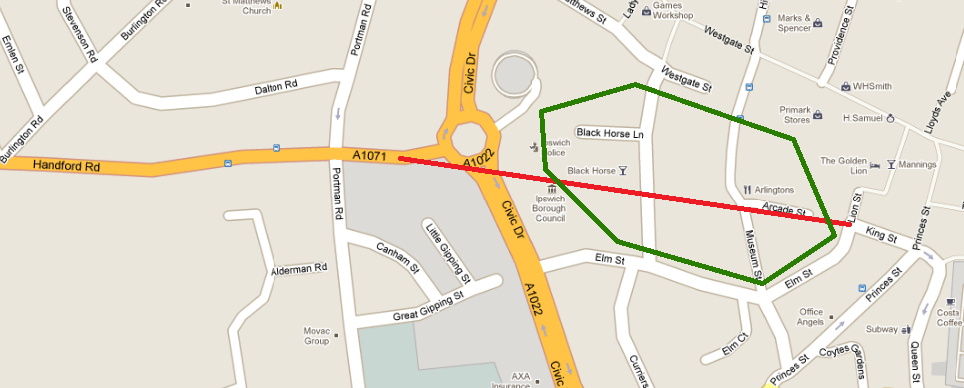
The red line shows where Keith Wade suggests Elm Street use to run before being re-routed by the castle in the 12th century. The green polygon is a suggested site for the, now missing, castle.

As for there being any remaining traces of the castle today – well, no there isn’t, not exactly. If the site explained here was indeed where the castle stood, then we could at least say that the area has been artificially raised and is left over from the earthworks of the castle, but until further evidence comes along to support that, it’s far from being proved.

The most interesting point to be brought out of all this is just how much and how quickly the landscape in England has changed over the past 1000 years. In fact, Ipswich shouldn’t be too put out about misplacing its castle. Of all the castles built by the Normans in the 12th century to defend the new land they had conquered (roughly 1000), only two still survive in any kind of recognisable form today – one in Lewes and one in Lincoln.

THE NEW ART OF PHOTOGRAPHY (PART TWO)

While I was halfway through writing my last post I realised that what was called for in this situation was a bit of historical detective work. What if I went and got those Victorian photo-books, then found the places where the original photographs were taken and took a comparative modern-day photo? To cut a long story short, that’s what I did.

Because photography was still in its infancy in the second half of the 19th century, and it was still the preserve of the rich gentleman who fancied himself something of an artist, it is down only to a few men that any photographs of Ipswich of the period survive at all. So we should take a moment to thank in particular William Vick (1833-1911), Robert Burrows (1810-1883) and Richard Dykes Alexander (1788-1865), who together seem to have taken the majority of the surviving Victorian Photographs of the town. The remaining early photos examined here were taken in the first decade of the 20th century by someone commissioned to produce a series of views for publication in the increasingly popular form of picture post-cards. Unfortunately their name has not survived on record, but it is almost entirely thanks to their efforts that well shot Edwardian pictures of the town exist.

What follows is the result of my afternoon of looking silly, taking photos of ordinary streets and shops in the town centre.


Ancient House – The original photograph was taken in 1858. Ancient House itself was built during the 16th century.

The Buttermarket, further down the road from Ancient House. The exact date of the original photograph is not known, however it is likely to be around the turn of the century due to the lack of tram lines, which were introduced after 1900.

This photo was taken standing on Carr Street looking over to Tavern Street. The original was taken in the early 1900s. The Great White Horse, which featured in Charles Dicken’s The Pickwick Papers, stands to the right of the picture.

A little further back from the previous photo, still in Carr Street, taken in 1906. New shops replace the old timber-framed ones.

A well known shop-front in Victorian Ipswich – Arthur Cross the draper selling all the latest fashionable gear, next to The Great White Horse in Tavern Street. Today the building houses both a T Mobile and 3 store.

Majors Corner in 1908. The street has taken a slightly different form now but you can still see the Co-operative building in the background, which was built in 1884.

Martin and Newby, Established in 1873. It used to be one of the main hardware stores in Ipswich. Now some of the shop-front survives, but the store itself closed down in June 2004.

Looking down Tacket Street, taken from Upper Orwell Street in 1906. The Unicorn is still there in the background.

St Helen’s Street in 1907. Note the tram-lines that ran throughout the town. The numer 23 tram here, which went to Lattice Barn or Derby Road – coincidently my bus route home from town now.

St Nicholas Street 1885. If you look carefully you can see the top of the Town Hall in the background of both photos.

St Peters Street in 1906. Little has changed aside from the addition of some new shops and the removal of the tram-lines.

Stoke Bridge – original taken in the 1880s. An iron bridge replaces the old one and thanks to the renewed regeneration of the docks the scene has changed significantly. In the background of the modern-day photograph you can see the new university building and new apartments including The Mill development.

Upper Orwell Street around 1904. Largely unchanged, the houses and church on the right hand side of the picture remain largely the same today.

Here, I have included a map showing where in the town centre each of these photos were taken.

Anyway, I hope you found that at least vaguely interesting – I did.

THE NEW ART OF PHOTOGRAPHY (PART ONE)

A couple of years ago I spent my university summer holidays decorating my grandma’s house after my grandpa died. I had to spend a lot of time clearing rooms of furniture that had accumulated fifty years or so of peaceful marital debris, before I could begin painting and re-carpeting. Often, while I was moving cupboards and bookcases from room to room, I would find interesting forgotten items – National Geographic magazines from the mid-1950s, toys from my childhood and German silver tankards from the second half of the 19th century among other things. One bookcase I moved out of my Grandpa’s room was a particular gold-mine for this sort of thing and was full of interesting books and pamphlets. Because I’m such a weed I needed to take the books from the bookcase and move them a bundle at a time into another room before I could carry the bookcase itself. Mid-way through this process I came across two thin books that grabbed my attention – being as I am a remarkably dull person – called Ipswich Remembered in Victorian and Edwardian photographs and Ipswich Remembered 2 in a second series of early photographs. As I often did when I made these kinds of discoveries, I decided that what I deserved right about now was a break and a cup of tea, and I spent the next half an hour sat on a large bucket of emulsion interestedly flicking through the pages of these photo-books, only to discover on standing up that my shorts were dripping paint onto the floor.

All this is a long, roundabout way of saying it’s really quite odd to look at pictures of your hometown taken only a century or so ago. First you see images that look completely alien, then you slowly recognise the curves of streets and pick out church spires and shop fronts that look vaguely familiar, until you realise that this is the street that you bought a pair of trainers on not more than five days ago.

So much has changed – often for the worse. But the really sad thing is that when we look back at photos like these we think that we’re viewing a by-gone era of solid Victorian trustworthiness and a time before the desecration of towns by newer, uglier buildings that often result in an unattractive mix of architectural styles. In fact, a lot of damage had already been done to the historically attractive and interesting parts of Ipswich Town Centre by then; this was actually its heyday. The Victorians and Edwardians (at least in Ipswich), it turns out, were just as bad as us in modern Britain in this respect.

One of the major casualties of Victorian age Ipswich was the Georgian Rotunda first opened in 1794, a domed circular building that was situated on Cornhill. This was Ipswich’s first ‘supermarket’ and housed all manner of shops and stalls. This was pulled down in 1812 – to be fair to the developers the Historian Robert Malster writes that reports survive that tell of the poor ventilation within the Rotunda, but if only photographs had existed then what an interesting thing it would be to see now.

(An artist’s sketch of the Georgian Rotunda)

The Tudor Market Cross, which had been the centre of town life since 1510 when it was given to the town by a well-to-do merchant called Edmund Daundy, and had been ‘beautified’ at the restoration of Charles II, was also replaced with today’s Town Hall. In 1812 town planners made the decision to demolish the Cross ‘in furtherance of the improvements that were then taking place’. But there remains plenty of evidence that this was not done without much regret from local people. According to G.R. Clarke the cross was in ‘excellent preservation’ and was actually very difficult to pull down.

(The Tudor Market Cross before it was torn down)

Perhaps most ruthless was the tearing down of the ancient Chapel of St Mildred in the name of modernisation, which had been built by the Wuffinga kings in around 700. St Mildred’s had stood for well over a thousand years and is sometimes referred to in literature of preceding centuries as ‘one of the most beautiful buildings in Ipswich’.

This is not to say that the Victorians didn’t bring their share of improvements to the town. The old Post Office and Town Hall date back that far, even if they did replace some pre-existing places of interest, and the Victorian regeneration of the Wet Dock helped serve to save the town from almost complete financial decline and obscurity. In many respects Victorian town planners actually did a good job of developing the town, it’s just a shame that in the process they also destroyed large chunks of its character.

(Victorian Ipswich still didn’t look too shabby)

History repeats itself constantly in this regard; just like the Victorians were keen to pull down much of what made the Ipswich of the past what it was – such as its central meeting place – and replace it with something more modern, but almost definitely less special, we are willing to do the same now. Towns and cities have to change over time in order to stay relevant to the people who live in them, it’s natural and necessary. What we should learn from the past however is the price that is often paid in the name of modernisation. Sometimes the things that make a place special aren’t the most practical to maintain and it’s easier to tarmac over them and build a new supermarket, but we have an obligation to ourselves and future generations to weigh that up against what we can lose in the process.

AGE AND NAME

It would be nice to start at the beginning. That’s usually a good place to start, but, predictably enough, it’s not that simple. Historians, if they’re honest with themselves, can do little more than venture educated guesses as to when the site that has now come to be known as Ipswich first came to be permanently settled. Peter Bishop in The History of Ipswich – 1500 years of triumph and disaster suggests that it was sometime around 550AD after Wuffa and his fellow marauding Swedes landed on the Saxon shore, whereas Carol Twinch in her equally originally named The History of Ipswich thinks it likely that Ipswich has maintained constant habitation from at least 450AD.

What is certain is that it was a long time ago. We can at the least say that the Ipswich area has been constantly populated with various peoples for at least around 1500 years and by more than 50 generations. 50 generations might not sound like a lot when casually inserted into a text like this, so let us just put that into a more meaningful context. A useful tool for this is the genealogies of the Old Testament. If you take a generation to mean around 30 or 40 years then since the time of Adam and Eve and their largely denounced fruit of knowledge nibbling (which was obviously a very long time ago), we’ve moved on to the tune of around 150-200 generations – I don’t know about you but I was expecting that figure to be higher. Anyway, of that amount 50 is evidently a sizeably proportion and it might get you scratching your beards to consider the fact that Ipswich (or Gipeswic as it was then known), had been well established for well over a thousand years before even the first glimpse of the continent which was to become known as America was reported back to the western world.

Where the name Gipeswic came from is yet another matter for conjecture. Depending on which local historians you care to listen to you will hear that the name certainly came from the town’s eponymous founder Gippa, or that he did not exist at all, and that in fact the town was named for the shape of the river Gipping. The argument for this is that the old English word ‘gipa’, meaning an opening or corner, fits the description of the river as it flows through the area where archaeologists believe the town was initially founded. The other story, as mentioned, is that our old friend Gippa turned up at the river fresh from his travels and decided this looked like a good place to set up a market sometime around 550AD. In Gippa’s time it was common for people to be named for a prominent characteristic they possessed, and as ‘Gipian’ is the old English verb to yawn, some people have made the leap to suggest that Gippa was excessively prone to yawning and that therefore a rough translation of Gipeswic into modern English is ‘Yawnsville’ – this alone gets this explanation my backing, but in fairness it is important to point out that there isn’t really any evidence or reason to trust this suggestion other than its romance.

How Gipeswic or Gippeswyk (again depending on your historian of choice), became Ipswich is much easier to explain convincingly. The ‘G’ before ‘i’ in ‘Gipe’ is silent, making the ‘i’ short, so this would have meant that gippa would have been likely to have been pronounced as Yippa. Over the next thousand years or so spelling eventually followed speech and with the occasional excursion into variants in between, such as ‘Gypewic’ and ‘Ipswiche’ (in medieval times the rule seems to have been: if you’re not sure just stick on an ‘e’ for good measure), we have eventually landed on Ipswich, which now, thanks to the widespread use of the written word should mean we won’t have to update our address books again anytime soon.

Well there you have it, there’s a taste of the history of this little, forgotten town in the heart of the 8th largest county in England. Now we know roughly how old it is and possibly where its name originated from. I hope you’ve found this first blog post as informative and interesting to read as I have found it to write.

This slideshow requires JavaScript.