You may have noticed that this blog has been relatively quiet the past few months. The reason for the lack of posts is that I have been working hard in my free time to put together my first ever local history book about Ipswich.
The book is a series of ninety photographic comparisons that contrasts Victorian and Edwardian Ipswich with the modern town. If you are interested you can order it from the publishers directly from here:
When you walk through Westminster and admire the impressive white stone that comprises the Palace of Whitehall, there’s a good chance part of what you’re looking at was supposed to be a Tudor college in Ipswich.
Cardinal Wolsey was a powerful man in the 1520s – in fact, to be perfectly honest, he was probably the most influential man in England, aside from the king. Henry VIII had delegated much of state business to Wolsey, to the point where he administered both home and foreign affairs. This was all rather incredible considering Wolsey’s origins which, while not being destitute, were still relatively humble.
Cardinal Wolsey
Born the son of a successful business man in Ipswich, Thomas Wolsey very probably studied at a local grammar school, before he enrolled at Magdalen College, Oxford. Wolsey’s glittering career began when he was ordained in 1498 and then became a parish priest in Somerset. Following this initial post he became Chaplain to the Archbishop of Canterbury, then Chaplain to Henry VII, and eventually served as Lord Chancellor to Henry VIII.
To put Wolsey’s importance into some kind of context it’s worth noting that he was responsible for organising the ‘Field of the cloth of Gold’ in 1520. This was a meeting of the powers of Europe, seeking to prevent future wars between Christian countries, rather like some kind of 16th century version of a United Nations meeting.
Wolsey was definitely one for building; during his years of power he spent much of his wealth on the construction of impressive buildings such as York Palace in Whitehall and Hampton Court. He also established Cardinal College, Oxford (now Christ Church College). To this institution he wished to add some fifteen feeder colleges in diocese around England, the main one was to be in Ipswich, his hometown.
Wolsey’s Gate in Ipswich
The college in Ipswich was to be built upon the site of the Priory of SS Peter and Paul and to this end the priory was duly dissolved; providing both space and funds toward the building of Wolsey’s proposed school. Building of the college began including the now cherished ‘Wolsey’s Gate’ that was only ever supposed to be a small entrance for people arriving by water (Malster, Robert, Ipswich an A to Z of Local History, Wharncliffe Books, 2005).
In the meantime, before the building work was finished, pupils had started their study at the institution. A letter from the master of the school attached to the college survives, expressing the thanks of the school and the people of Ipswich, including examples of some of the handwriting of the boys in attendance.
Things were not destined to stay so rosy for Wolsey; the rise of Anne Boleyn saw his downfall. Anne took serious offence when Cardinal Wolsey failed to secure a quick annulment of Henry’s first marriage to Catherine of Aragon. Anne persuaded the king that Wolsey was deliberately putting a halt on the process. As a result, Wolsey was stripped of his office and the impressive buildings he had erected.
The downfall of Wolsey spelled the end for his grand plans for the name of his Cardinal College in Oxford, and the building itself of his main feeder college in Ipswich.
Wolsey’s Gate – originally designed to be the river entrance to the college
Now all that remains is Wolsey’s Gate; the last small fragment of Wolsey’s aspirations for his home town. In 1532, all the ‘timber, lead, wainscot and white stone of divers kind’ that remained in Ipswich, waiting to be used for the construction of the college, were packed up and taken by sea from Ipswich to the Galley Key by London Tower, ‘to be used for the king’s buildings at Westminster’ (Redstone, Lilian J., Ipswich Through the Ages, East Anglian Magazine Ltd, 1948). In a cruel turn of fortune, the very construction materials from Wolsey’s buildings in Ipswich were (now repossessed by Henry VIII) used to expand another of Wolsey’s projects in London – York Palace in Whitehall – that now belonged to the king.
As for Wolsey, he was granted a last minute reprieve from Henry and allowed to remain Archbishop of York. However, he was later accused of treason and summoned back to London to answer the charge. On the journey to the capital Wolsey fell ill at Leicester and subsequently died on 29th November, 1530.
An interesting footnote: Just as Wolsey had erected impressive buildings as residencies during his life, he had similar plans for his remains; he had planned a magnificent tomb in Windsor complete with a carved black sarcophagus. In the event of his unforeseen death in Leicester, he was buried in the Abbey of St. Mary of the Meadows. His grave is now unmarked and unknown. The black sarcophagus had to wait a further 275 years to be used. It now lies in the crypt of St. Paul’s Cathedral and contains the remains of another great Briton, Horatio Nelson.
Happy New Year everyone! This is just a post to say thank you so much to Kelly Wadsworth for creating a new amazing header for the blog from scratch!
Kelly is a fantastic graphic designer and if you would like to see more of her brilliant work then you should check out her blog and online portfolio of work here: http://www.kellygraphicdesign.blogspot.co.uk/
This is my first attempt at a prezi – so sorry if it’s a bit amateur. You can click on any of the pictures, clips and text if you want to zoom in on them as well as moving through the presentation using the arrow keys. Hope it’s interesting.
I decided to go to Ipswich Museum for some inspiration for my next blog post, especially since I hadn’t been there for years, but while I was walking around I thought it might be fun to write my own little review/guide to the place. What follows is a selection of highlights from my walk around the museum.
Ipswich Museum
Victorian Natural History Gallery
Rosie the Rhino
The first thing you see when you walk through the doors into the museum is the woolly mammoth and in my opinion that’s exactly what you want to see when you walk into a museum. The whole of this first hall is filled with taxidermy – every animal from mouse to monkey to lion, but it’s the mammoth and its sheer size that grabs you first. I walked over and looked up at its hairy face and could instantly remember coming to the museum as a child and wanting to jump over the barrier and climb up on to its back, the same went for the rhino and the giraffe. Standing there, surrounded by stuffed animals of every variety with blank eyes, I found that I still wanted to. I shot a look over my shoulder at the hovering security guard, but he looked like he’d had a long day and I didn’t think it would be fair to put him through the ordeal of tugging a 24 year old man-child off a prehistoric mammal replica, and anyway, I still wanted to see the rest of the museum.
Here are a couple of interesting facts about the Natural History Gallery to keep you going:
1). The gorillas on display known as the Du Chaillu’s Gorillas were the first ever seen in Britain.
2). The rhino (known to visitors as ‘Rosie’) arrived at Ipswich Museum in 1907 and was traded with the British Museum for a pig.
Ipswich Museum’s Victorian Natural History Gallery
Unfortunately, Rosie had her horn stolen in July 2010 and the two men seen driving off from the scene of the crime were never caught. Happily though, the horn has been replaced with a replica and visitors have been leaving messages of congratulations to the curators and Rosie in a comments book next to her ever since, which is very sweet.
Anglo Saxon and Early Ipswich
I walked through a glass door into another part of the museum that houses lots of original artefacts and replicas from Suton Hoo that tell the early story of Ipswich complete with Anglo Saxon dressing-up clothes and the life size humanish looking models you see in all regional museums. One was holding a tool over a piece of metal and looked like he’d been trying for a long time to decide whether or not to hit it, another was of a woman who seemed to be in a similar quandary over whether she should continue with her weaving.
I began to look around and was drawn over to a display inviting me to create an Anglo Saxon name for myself, all you had to do was spin two discs – one with prefixes and another with suffixes – and hey presto! Anglo Saxon name! I spun the wheels and was rewarded with Fri-Wyn or ‘Free-Joy’ in the modern English translation.
I was just getting interested in a display explaining the roots of early Ipswich when the door to the room swung open again and two ex-pupils from the school I work at walked in.
“Oh it’s you” said the first one.
“You ust to work at Westbourne didn’t-cha?” said the second.
“Hello, yes I still do” I said
“It’s a dump” said one of them very matter-of-factly
“How’s my brother doin’?” asked the other
The conversation kept going. I won’t bore you with the whole thing, but the best thing to come out of it was a mildly humorous moment when I asked one of them what they were doing at college now and thought they said geography when they had actually said photography. By the time I had managed to escape, one of the security men arrived ringing a bell and announced it was closing time and that I needed to leave the museum. The rest of the rooms would have to wait for another visit.
Bones and Fossils Gallery
I left myself a lot longer before closing-time
Ipswich Museum’s Geology Gallery
when I next returned to the museum. I started in the long rectangular room that houses the museum’s considerable collection of bones and fossils. I began prowling up and down the cases looking for something that took my interest. Along one wall were some heavy Victorian display cases displaying the skeletons of various animals as they would have been arranged in life (you really can’t move for dead animals in Ipswich Museum). Apart from bones and fossils this room also devotes itself to telling the story of Suffolk’s geological past over the previous millennia, unfortunately, although I really tried I just couldn’t get passionate about changes in soil composition so I thought it was time to move on.
The main things that I took away from this room were that thousands of years ago some elephants used to be a lot bigger than they are currently and that they had straight tusks. The other was that lions used to be a common enough animal to find in the wild around Ipswich about 210,000 years ago, where, according to an archaeological dig under Ipswich’s Stoke railway tunnel, they were busy chasing red deer.
The Bird Room
You could never accuse Ipswich Museum of being obtuse with their labelling of rooms, the Bird Room is, as advertised, a room with lots of birds in it. I’m not really sure what else to tell you about the bird room, apart from to say it is impressive to see so many different breeds of bird from all over England and Scotland all in one place and it appeals to all ages if the
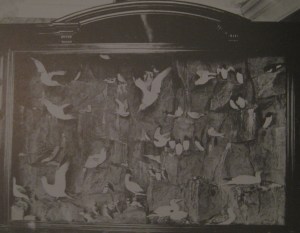
A photograph of the Bass Rock Case taken soon after its installation
enthusiastic French gentleman and his granddaughter were anything to go by. To be honest, this wasn’t my favourite part of the museum; all the dead animals with their vacant faces and fake eyeballs were beginning to get to me by this point, so I quickly made for the exit. Before I reached it however, I came to the pièce de résistance of the room – the Bass Rock Case. This full size diorama, that includes fifty-two seabirds, aims to recreate a scene from the Bass Rock gannet colony off the coast of Scotland complete with eggs, seaweed and bird poo running down the cliff face. The scene was created thanks to the legacy left by Lord John Harvey in 1902, this struck me as quite an unusual thing to request in your last will and testament, but each to their own.
Egyptian Gallery
I walked into the Egyptian Gallery, which didn’t exist when I used to visit as a child. I was pleasantly surprised at just how good this new section (opened in 2010) was. For a start there are lots of genuinely impressive artefacts on loan from the British Museum on display including some large statues of Various Egyptian gods, some of which are around 4,000 years old. In fact, Ipswich Museum already had an impressive stock of items from Ancient Egypt donated in the early 20th century by friends of the Museum who were keen to prevent grave robbers from getting their hands on them for profit.
Egyptian Gallery
Some of the more impressive objects are kept within a central chamber inside the gallery that is accessible by a doorway for adults and a giant mouse hole in the wall for children to crawl through. There were a lot of families with small children around me at this point and the kids were going crazy for the Egyptian history, when they saw the mouse hole it sent them over the edge and for a good ten minutes it was hard to move for running, screaming, crawling children.
After the families had departed I went into the chamber too (through the door not the mouse hole, although I was tempted). Inside it was really interesting; the curators had thoughtfully placed mirrors at the correct angles to allow you to see inside gold coated masks and sarcophaguses. Seeing the stained cloth inside of the masks particularly forced me to think of these objects not just as pieces of intricate, beautiful art work, but also as the shelters of human remains that they were. It was a bit spooky, but also very fascinating. The other thing that stood out to me was just how many things the Egyptians used to mummify, not just people and cats, but birds and crocodiles, pretty much anything they could get their hands on it seemed.
I walked out of the Egyptian Gallery,
Underfloor display in Egyptian Gallery
looped my way around the balcony of the Natural History Gallery looking down at all the rigid animals below and made my way down the main staircase back to the reception. It was time to go, there was still more to see but that’s plenty enough for this post, and I think I’ve taken up enough of your time already. Anyway, if you’re still interested by this point what are you doing? You’ve clearly got enough time to go and make a visit yourself.
It’s been a long time since I wrote my last post and it took me a while to get back into the swing of things, particularly when coming to chose a subject to write about. whilst casting about for a topic it struck me driving past a road sign welcoming me to ‘Ipswich the County Town of Suffolk’, that I had no idea why Ipswich, of all Suffolk Towns, had become the County’s top dog.
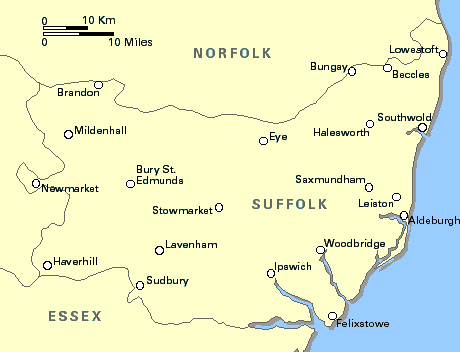
There have been well established settlements in Suffolk for longer than nearly anywhere else in the country and yet it remains almost stubbornly non-metropolitan. While Suffolk has largely clung to its rural roots, there have been small pockets of urbanisation that have vied for supremacy within the county for centuries. Why it is that Ipswich emerged and remained the most dominant of these and became the County Town is the subject of what follows.
Ipswich’s awkward position in the south-east corner of the county has caused some difficulties over the centuries
The location of Ipswich has thrown up several road blocks for the town over the centuries and could well have seen Ipswich’s importance diminish quite considerably if history had taken any of several slight deviations. This was particularly true when it came to Ipswich’s role in the Shire Moots/County Courts since the earliest developments of the country’s parliament. This was important because considerable power followed the judges who sat in them.
During the 13th and 14th centuries Ipswich played host to the early Shire Moots where the Kings judges, that did not then sit in one place but perpetually moved around to various sites, pronounced their verdicts. They did this in shirehouses, although the knowledge of the exact placement of Ipswich’s original shirehouse has been long since lost. For some reason the inhabitant
s of Ipswich allowed their shirehouse to rot away and thus when combined with Ipswich’s awkward location, the king’s judges decided to make Bury St. Edmunds their new stop off point for the courtly affairs of Suffolk upon their circuit between Cambridge and Thetford.
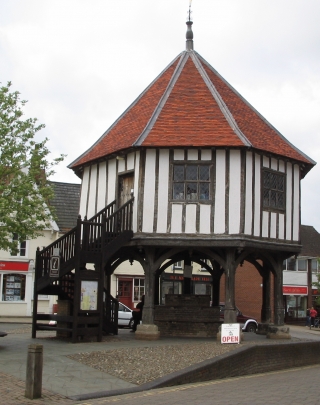
Wymoundham Moot Hall, an example of a 13th century East Anglian meeting place for courtly affairs
Things remained this way until 1698 when Ipswich, led by Sir Samuel Barnardiston its Member of Parliament, secured a grant of £300 from the county towards building a new and up-to-date Sessions House. In fact, even this could not persuade the judges to cover the longer distance to Ipswich and it was only the fear of smallpox in Bury in 1740 that drove them to the new hall at Ipswich and led to it becoming customary to divide the assizes between the two towns.
Ipswich’s location in the far south-eastern corner of Suffolk has been a drawback in the past, not just in attracting judges to the town but also, perhaps more importantly, in attracting trade. What overcame this problem for Ipswich was the navigability of the river Gipping into the heart of the county. From the middle ages onwards the waterway had been used to transport heavy materials and goods such as wine, salt and stone from the coast further inland, but only after the Navigation Act of 1793 was it opened up to large scale traffic through the spread of canal networks, allowing barges to deliver coal throughout the county as far as Stowmarket. The river routes from Ipswich into the county made it all the more centrally important to the county because there was a lack of good roads in the surrounding area until relatively recent times. This reliance on water transport made Ipswich, near the coast and on the river, an obvious centre of business and communication.
The introduction of railways to Suffolk only served to strengthen the position Ipswich had as a centre for commerce in the county, drawing in more businessmen, labourers and customers from the surrounding smaller settlements. Ipswich market grew as a result and ever since all the villages of south-eastern Suffolk have made Ipswich their centre for shopping, amusement and business.
Ipswich had become a centre for entertainment in the county by the Tudor period, by this time the docks had established Ipswich as a reasonably prosperous place, this was reflected in the high concentration of knights, gentry and wealthy merchants who lived in the town, who in turn made it possible for the development of theatre and dramatic performances that mainly took place in the Moot Hall. At the same time, what we might now consider, less high brow entertainment was becoming available in Ipswich; bear baiting became a regular feature on the Cornhill and players of the cornet and lute walked the streets in the hope of adding to their yearly wage.
The Cock and Pye Inn, which used to play host to one of the county’s favourite forms of entertainment
After the years of Puritan control, when entertainment across the country was for the most part eliminated, (In 1637 the Ipswich bailiffs actually paid the king’s servants not to play in the town) Ipswich once again became a hub for amusement. New theatres including one on Tacket Street were built and horse racing came to Ipswich by the mid 1700s taking place on the nearby heath.
Other sports popular at the time that attracted large audiences to the town included cock fighting, most notably at the aptly named Cock and Pye Inn, which still remains so named today. Ipswich was fortunate to be well endowed with many good Inns and Hotels and remained well visited for entertainment and holidaying well into Victorian times, the author Charles Dickens often staying in the regionally famous White Horse Hotel and writing it into his first novel The Pickwick Papers. All of these attractions helped make Ipswich an obvious place to develop county infrastructure.
Another factor that has made Ipswich central in importance in Suffolk has been its role in caring for the sick of the county. During the 19th century when inoculations against illness became widespread, Ipswich became a hub for such treatment for East Suffolk, so much so that in the early days of small pox inoculation doctors refused to inoculate patients from outlying villages because the large numbers of people crowding into the town threatened an epidemic.
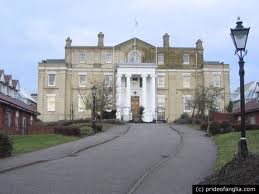
The first purpose-built hospital in Ipswich. Today it still performs a caring role as a care home
The East Suffolk and Ipswich Hospital was opened in 1836 for about 50 in-patients and has continued to expand ever since, spreading to different sites around the town, cementing the role of Ipswich as the principal care provider for a large area of Suffolk.
Ipswich has managed to develop and maintain features that have made it vital to a largely rural backwater county like Suffolk. It has provided a source for entertainment, important trade links from the coast into the heart of the county and secured a prominent role in courtly and administrative affairs over the previous centuries. It has also become a regional base for essential services such as the police and healthcare system in the local area. Through all this it has also dealt with competition from towns such as Bury St. Edmunds and Stowmarket as a provider of goods, resources and other attractions of power to become regarded as of central importance to the region and become the county town of Suffolk.
When I was around 7 or 8 years old, my mum took me and my brothers on the Ipswich open air bus for the first time. This was a pretty big deal from what I remember. Scores of parents with their young children would wait just down the road from Crown Pools (for hours it would seem in kid world), in sizzling heat – for the bus only ran for a few weeks in the height of summer – for an open air bus to pull round the corner and send all the kids crazy with excitement. The main reason all the kids were falling over themselves to get on the bus was because anyone with any sense knew that the climax to the bus tour was a trip across the Orwell Bridge (below). If you were 7 years old in mid-1990s Ipswich, being blown around by high winds on a high bridge on an open air bus driving at 40mph was easily the most exciting thing on the cards for you. It might be sad but it’s true.
The Orwell Bridge
The reason I bring all this up is that before the bridge there was a tour to be sat through. Needless to say this was quite boring and also quite pointless, because all the children on the bus were too young to understand or care and all the parents were too busy stopping their children from climbing over the side of the bus to listen. Genuinely, the only thing I remember about the history of the town from those tours was the point at which we went past the Old County Hall, when the guide would very importantly announce that this was the place where the Simpson divorce was decided and that this had important consequences for the royal family and the country.
If you’ve watched the multi-award winning King’s Speech recently then you probably remember Wallis Simpson as the woman Edward VIII abdicated to marry. The film portrays her in a fairly bad light, but as far as I can see from a bit of research, they went pretty easy on her. To put it bluntly, she seems to have been a fairly big Nazi supporter who slept around with a lot of men and abused her position to pass British intelligence to the Germans before and during World War II. She was a bad egg.
In the autumn of 1936 Wallis Simpson spent six weeks living in Felixstowe in order to gain residential qualifications to have her divorce hearing held in Ipswich, a place in which it was hoped minimal publicity would be gained. Unfortunately for Mrs Simpson this was not to be a low key affair. Associated Press of America was informed of the pending case and the world’s press promptly arrived in Ipswich for the hearing that was to take place on 27th October.
The Old County Court on St. Helens Street
On the day of the hearing the police took the precaution of closing off St Helens Street to prevent the press taking photos of Wallis Simpson as she arrived at the County Court. Naturally, the press, always keen to report a royal public scandal, were not going to let a little thing like that get in their way and took up situations in buildings along St Helens and Bond Street. It’s an interesting example of how much freedom of the press has come on over the past few decades that police stormed these buildings and impounded any camera that they found.
The hearing itself lasted only 25 minutes. The judge, Mr Justice Hawke, seems to have been fairly unhappy about permitting Mrs Simpson her divorce, but in the end after hearing evidence from members of staff from a hotel at Bray-on-Thames, who told of her husband sleeping with another unnamed woman, he relented and reluctantly said ‘Very well, decree nisi.’ (Meaning that unless further evidence was brought before the court within six months to change the decision, then their Marriage would be dissolved).
After the decision Mrs Simpson sped out of the court and was driven at high speed to London. In another attempt to slow down and silence the press a policeman followed her car and then spun his own car round in the middle of the road to prevent them from pursuing. Those who did manage to get through found themselves held up by a ‘routine’ traffic check on the A12 and were asked to provide their driving documents.
Wallis Simpson shaking hands with Adolf Hitler
The hearing in Ipswich led to a crisis that was only resolved in December 1936 when Edward VIII announced his abdication. They were married the following year in June.
In the following years and throughout the 2nd World War the couple lived together in various countries around Europe. As mentioned, Wallis fed intelligence to the Germans through Joachim Von Ribbentrop, the one-time German ambassador to Britain who she had had an affair with. It was always Hitler’s plan, by the way, to make Edward his puppet king in England after an invasion of Britain and so presumably with Wallis as Queen.
As Edward VIII only abdicated due to his wish to marry Mrs Simpson, if she had not gained her divorce he would have remained King with her as his mistress leading into WWII. Thank goodness history took the turn it did that day on the 27th October 1936 in Ipswich. Otherwise, Britain may have found itself fighting a World War in the strange situation of the King’s mistress passing information of the highest importance to the enemies of his subjects.
On the 25th May this year it will be 811 years to the day since Ipswich was granted its Royal Charter in 1200. It seems appropriate then, to discover what we can about this important event in Ipswich’s history just in time for us all to pop some champagne corks and light some fireworks in celebration of what was really the town’s first light-toed, faltering steps towards a more democratic form of local governing.
It’s hard to understand the importance of a royal charter today when we take for granted all the things that in the distant past would have been novel and liberating. Now royal charters do little more than give a stamp of approval to businesses or institutions, but in the early 1200s they would have been considered far more valuable. Town charters in the Middle Ages usually made the inhabitants ‘free’ by way of lifting them out of the feudal system as opposed to those who lived in the countryside and villages as serfs (a form of bondage close to slavery). Not only this, but Ipswich’s charter gave the men of the town the ability to elect two bailiffs of the town to look after their interests. The charter also led to Ipswich being allowed to set up one of the first merchant’s gilds in the country to organise the town’s trade.
Ipswich’s Royal charter was signed by King John (of Robin Hood fame), and is one of the oldest royal town charters in England’s history, it even precedes the Magna Carta by fifteen years.
The charter’s 800th anniversary celebrations in the year 2000 have fostered a misconception in recent times that King John was present in Ipswich on the day of the signing, but in actual fact he was busy in France at the time he sealed the charter, at Roche d’Orival near Rouen, and the charter would have been brought to Ipswich by a Herald on his behalf and did not arrive in the town until some days later.
St Mary-le-Tower (left): Ipswich’s first step towards a regional elected government was taken in the churchyard.
After the townspeople received the document, they gathered on the 29th June in the churchyard of St Mary-le-Tower, which remains the civic church of Ipswich today, to elect two town bailiffs and four coroners (government officials). They then met again on 2nd July to choose twelve portmen.
At that second meeting of the townsmen an oath of obedience to the bailiffs, coroners and portsmen was taken by those present. The people then swore to uphold the honour, liberties and free customs of the town while stretching their right hands out towards a Bible that was held aloft.
Ipswich is very uncommon in having a preserved account of what happened when its people received their charter and of how the local people met and decided the way their town should be governed from then on, which is incredibly useful to historians studying the period in detail today.
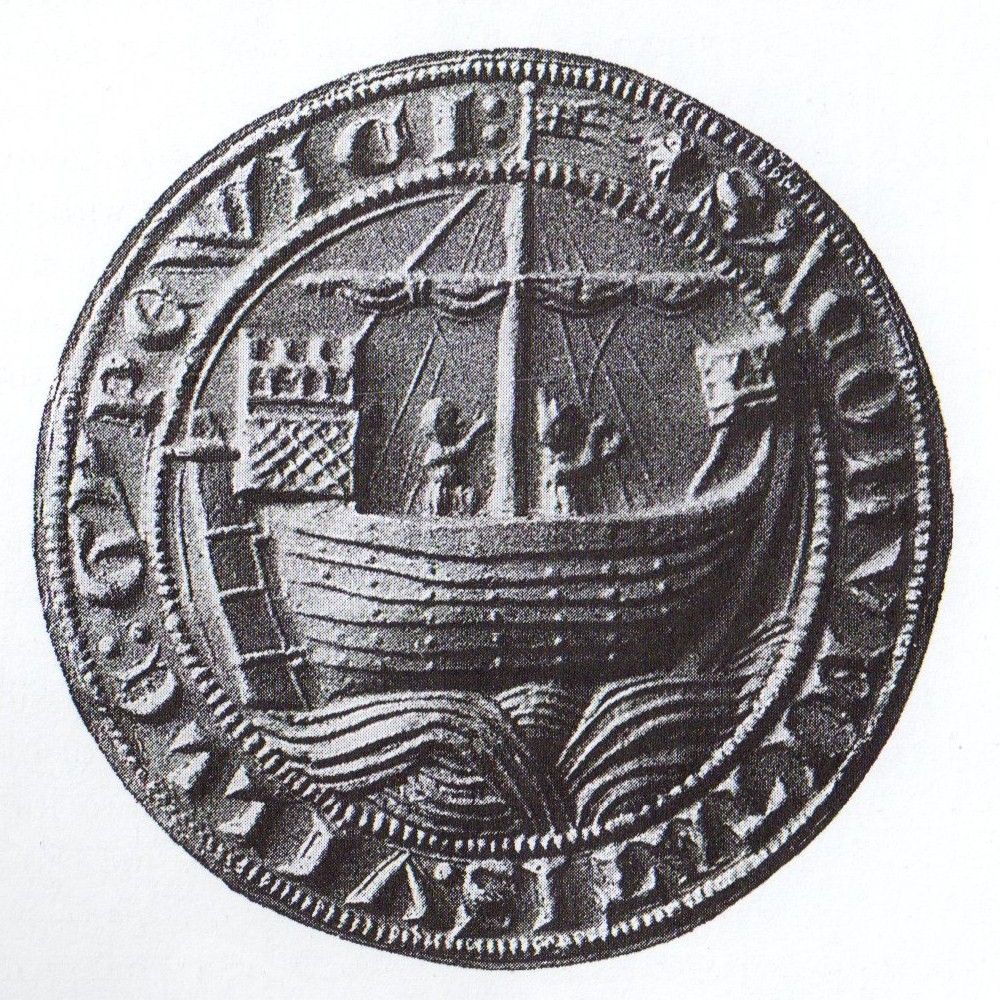
(Left): A seal created and used in Ipswich a few months after the granting of the town charter by King John.
So, there you have it. It’s not exactly the Declaration of Independence or the Emancipation Proclamation, but I like to think it’s one more small piece of the democratic jigsaw, and even if you disagree we’ve still learnt something new, and that’s the main thing.
Patriotic Education was introduced in China in 1989 in the wake of the Democracy Movement that met its end in the Tiananmen Square massacre. Since then, children all over China have grown up with the concept of guochi (‘National Humiliation’) drilled into them in the history classroom. The narrative the Chinese government wish to install in this way is that China was humbled by foreign powers during most of the 19th century because it was weak, now the Communist Party has taken over, made the country strong, and put a stop to this, and rightfully deserves the peoples’ support.
The list of foreign interference in the form of unfair treaties, military confrontations and ruined historic buildings e.g. the destruction of the Summer Palace in China during this time of imperial encroachment is almost limitless. Unfortunately, Europe, and particularly Britain, took a leading role in the exploitation of China’s trade possibilities. The Ching dynasty and those in charge all over China were fairly hostile to the new technologies that westerners offered, all too eagerly, to bring over with them. Many Europeans, however, saw the huge untapped opportunities in the country for rail transport. The only obstacle was overcoming the natural Chinese opposition to what they considered ‘flame breathing machines’ and the laying of railroads, which according to most Chinese villagers would disturb the feng shui of the areas it ran through.
Understandably, at the time as well as now, there was and is resentment from many Chinese people for the way the imperial powers subjugated their people and treated their land. This was the environment in which six men from Ipswich set out to attempt the unlikely and unwanted task of building the first railroad in China. On top of all the other hardships they would have to face in the process, it’s worth remembering that they probably weren’t too welcome there either.
(Above) The ruins of the Summer Palace destroyed in the Arrow War – one of many important sites that the Chinese government point towards to support the concept of guochi.
Richard Rapier, of the company Ransomes and Rapier based in Ipswich, was a man with a plan; he wanted to be the person responsible for the first railroad in China. He understood the very real gains on offer if China was truly opened up to Western travel and commerce through the development of a Chinese rail network.
Rapier took his first real shot at the project in 1872, by arguing that a miniature railway could be sent as a gift from the British to the emperor, seventeen year old Tung Chih. Rapier’s idea was to sweeten the new emperor up with his very own ‘toy’ train, so as to inspire the Chinese Imperial Court to permit or even encourage the development of full sized railways in the face of the opposition being experienced. Unfortunately for Rapier’s proposal, the Chinese were seen to have something of a superiority complex at the time and it was feared that any gift of such a size would be seen as a form of tribute, which could undo much of the work done by the British to counter the Chinese perception of superiority. This spelled the temporary end to Rapiers ambition. It was also unfortunate for Tung Chih, who, without the distraction of a toy railway, turned to the next best form of entertainment – Peking’s brothels – resulting in his death just two years later, at the age of nineteen, from a combination of syphilis and smallpox.
Despite this set back, Rapier continued to work on the development of a lightweight locomotive and railway that could be shipped to China, and in 1875 a real chance finally came for him to realise his dream.
The Woosung Road Company requested a meeting with Rapier to discuss supplying a small railway for Shanghai. Upon the companies visit to Rapier in Ipswich, he so impressed them with his little engine ‘pioneer’ they decided they had found the right man and at once engaged him to provide the entire railway system they had in mind.
Pioneer – China’s first railway engine.
With a deal agreed, Rapier set about manufacturing and assembling China’s first railway in his Waterside Works in Ipswich. All this took place without the permission or slightest knowledge of the Chinese government.
On the 1st October 1876 the engine, railway and six Englishmen left England for shanghai via America in the SS Glenroy. The six men from Ipswich were: Gabriel James Morrison M.Inst. C.E and his assistants John Sadler as chief foreman, William George Jackson and David Edward Banks as engine drivers, John Sadler Jnr. as second foreman and George Sadler as general assistant.
Upon their arrival in China these men, with the help of Chinese labourers, worked to lay the first railroad in China’s history along with bridges, turntables and stations from Shanhai to Woosung. This was no easy task as they had to deal with an extreme climate and long hours of arduous work, which caused them severe health problems. By September 1876 the project had cost the senior John Sadler his life with only half the line being laid. Then George Sadler became ill and had to be sent home under the care of his brother John. This left the project very short staffed, but even faced with these difficulties the team still managed to get the line open and running a passenger service by 1877.
China’s first railway ran from Shanghai to Woosung (now part of an enlarged Shanghai)
Pioneer, the first train to be used on Chinese tracks, was set on a 30” gauge to fit the new line being built, it was capable of running up to 20mph and was able to haul up to 20 tons. Two further Ipswich built engines were transferred to Shanghai to be used for the new passenger service named Celestial Empire and Flowery Land, these were improvements on the Pioneer design and were able to haul more weight and travel at faster speeds.
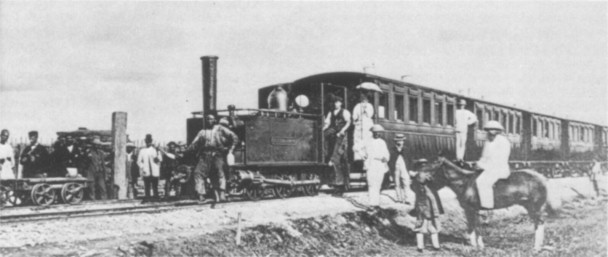
Celestial Empire pulling the Shanghai to Woosung passenger service
Things didn’t get any easier for the men from Ipswich after the railroad was completed. Not long after the line was put into service a depressed Chinese man laid down on the tracks and was decapitated by a train leading to a diplomatic incident.
Perhaps the biggest problem was that the Woosung Road Company, who had initially made a deal with the Chinese authorities for the project, and who had engaged Rapier to carry it out, had bent the truth (to put it mildly), when making the deal. It was no coincidence they had left the word ‘rail’ out of their company name. The authorities were outraged to discover that a railroad was being constructed by Englishmen from Shanghai to Woosung rather than the road they had agreed to.
The original agreement had made provision for the Chinese to buy back the road if they wished; in October 1877 enough cash was raised and the authorities acquired the line. It was thought that with the considerable popularity the line had found with Chinese passengers the service might continue, but this was not to be. On the day the Chinese bought back the line they announced its immediate closure as of 7pm.
The line was torn up and thrown into the river along with the rolling stock and equipment. Less than two years after work commenced on the line it was made to look as if it had never existed. The remaining English workmen, Banks and Jackson, returned to England.
Neither man decided to return to the Ipswich Waterside Works, probably for fear of being sent back to China or somewhere even more remote. Banks went to the Marine Workshop at Parkeston Quay and Jackson became locomotive superintendent on Southwold Railway.
Today this Ipswich venture is close to being forgotten. In China it is often thought that the Kaiping Tramway, built in 1879, was the first Chinese railway and for many British people this is just another example of imperial unwanted interference around the globe that most people would prefer to forget. Good or bad this is still part of our history and quite an expectional part at that. At the very least, these men from Ipswich deserve our respect for their efforts in the face of such trouble.
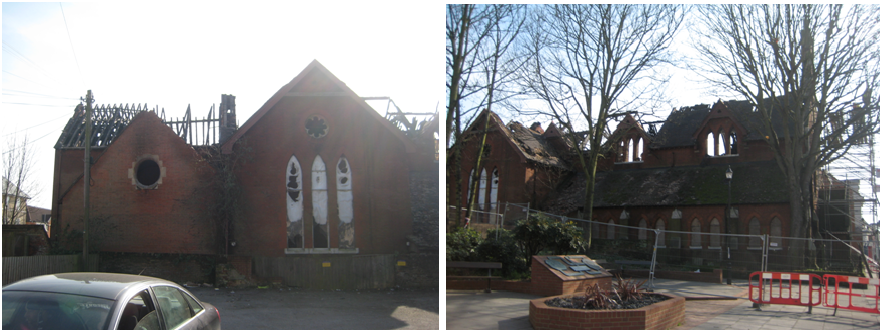
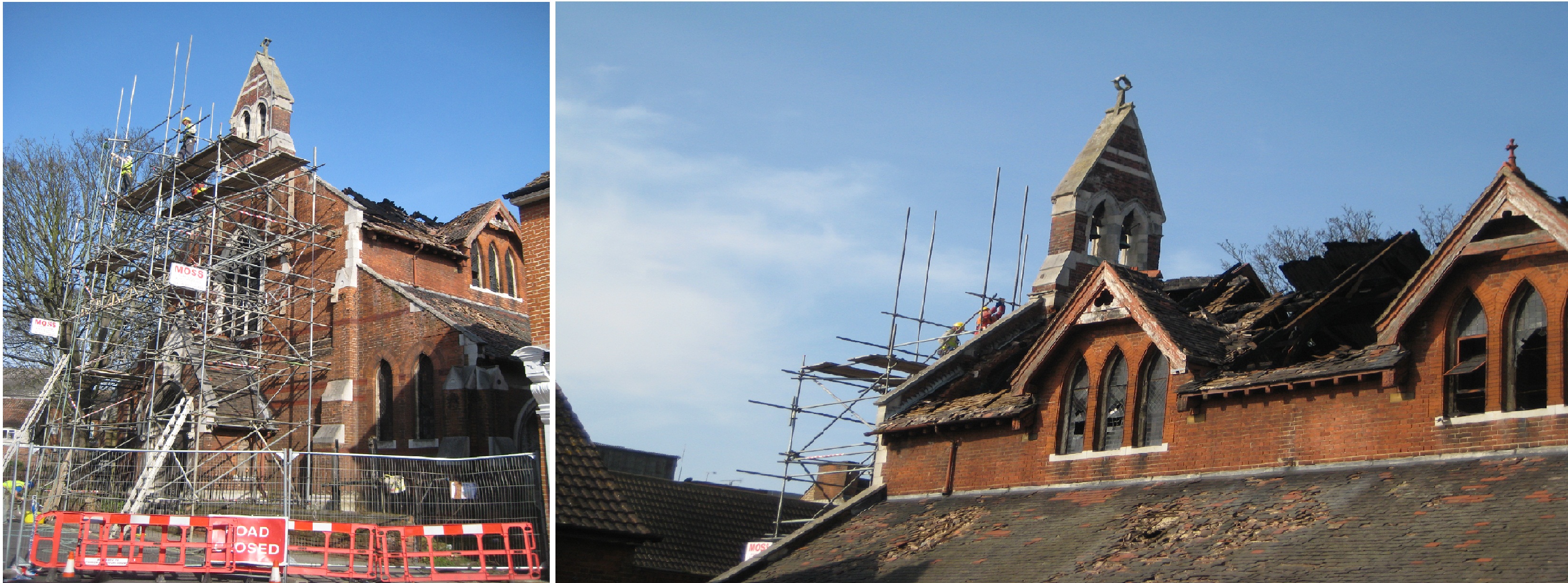
On the 7th March 2011 the Church of St Michael’s caught fire, the roof promptly collapsed in on itself and the interior was left to smoulder for some time as the building was declared structurally unsafe to enter. All this took place just eleven days after a young, rather good-looking, amateur historian made a new post on his blog about the Victorian New Art of Photography, which included a then-and-now shot of Upper Orwell Street including St Michael’s – as far as I know the last ever picture taken of the church with its roof in one piece.
The fire at the church has caused some controversy, as the building that had been empty since 1997, had recently been acquired by a group seeking to turn it into a Muslim-run community centre, which had unfortunately not insured the building. As the police opinion is that the fire was a deliberate act of arson, accusations have naturally already flared up.
That’s not what this post is about however; Ipswichhistory is more bothered about the loss of an historic grade two listed building in the town, than the politics behind it. So here is a swan song for the church – its very own concise history.
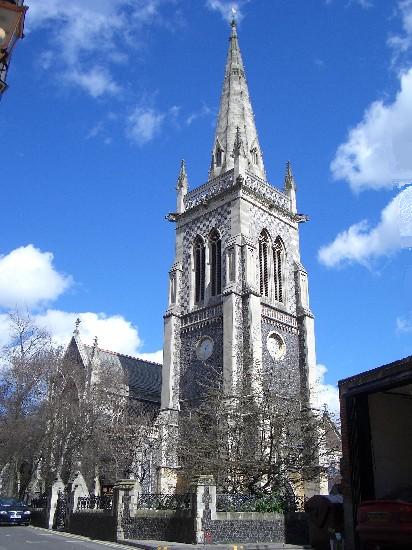
The last ever photo (as far as I can tell) of an intact St Michael’s. Now I just wish I had stood a bit closer.
St Michael’s was built during the early 1880s, the foundation stone being laid on 28th May 1880. It was designed by the Ipswich architect E F Bishopp. If we’re honest, it had never been one of the most attractive churches in the town, but it remains a solid representation of the times that made it; in a Victorian town with prospects to grow in population, both overall and in terms of the size of its Church of England congregation.
Large areas of slum housing existed around the church when it was first opened and it was built with an aim to serve the people who lived there. Upon opening in 1881 the church had space to seat 360 people. By the 1930s it had grown its capacity to 750, which gives some idea of how important a centre of community it had become. Groups run inside the church included: Girl guides, Brownies, Bible study groups, the 25th Ipswich Scouts and Cubs, and a Mothers Union, among others.
Towards the end of the 20th century the size of its congregation began to dwindle, thanks to ever depleting church attendance. This was also not helped by the fact it was very close to three other Church of England congregations at St Helens, and the parish churches of Holy Trinity and St Pancras.
St Michael’s struggled on into the 1990s, partly because of its unusually Low Church character; at its end, it could claim to be the only church in Suffolk that had never used anything other than the Book of Common Prayer. It finally closed its doors for good in 1997.
The church was already a sorry sight before the fire after being left vacant for so many years; the windows were boarded up and the roof was beginning to come away.
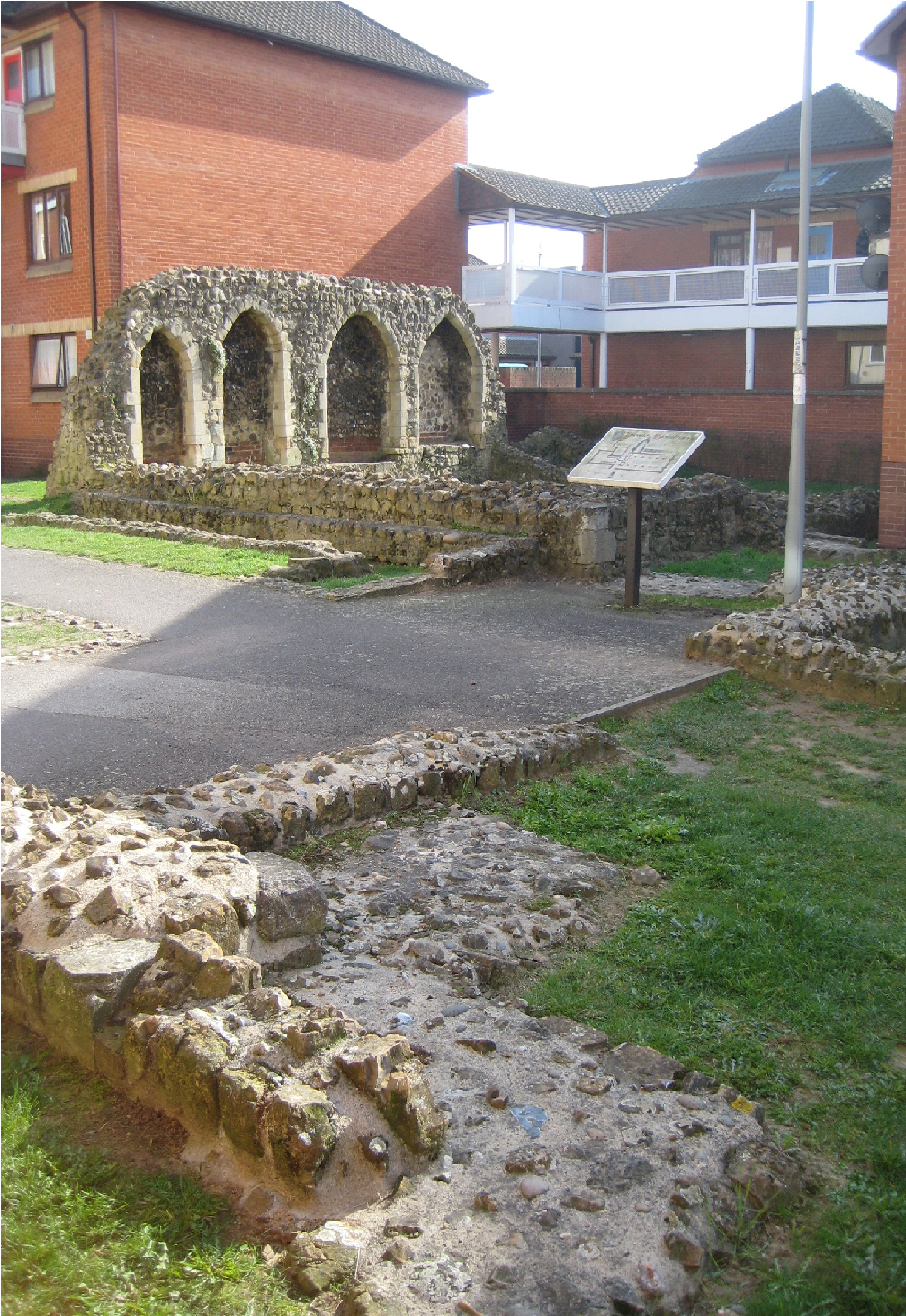
The remains of Blackfriars (left).
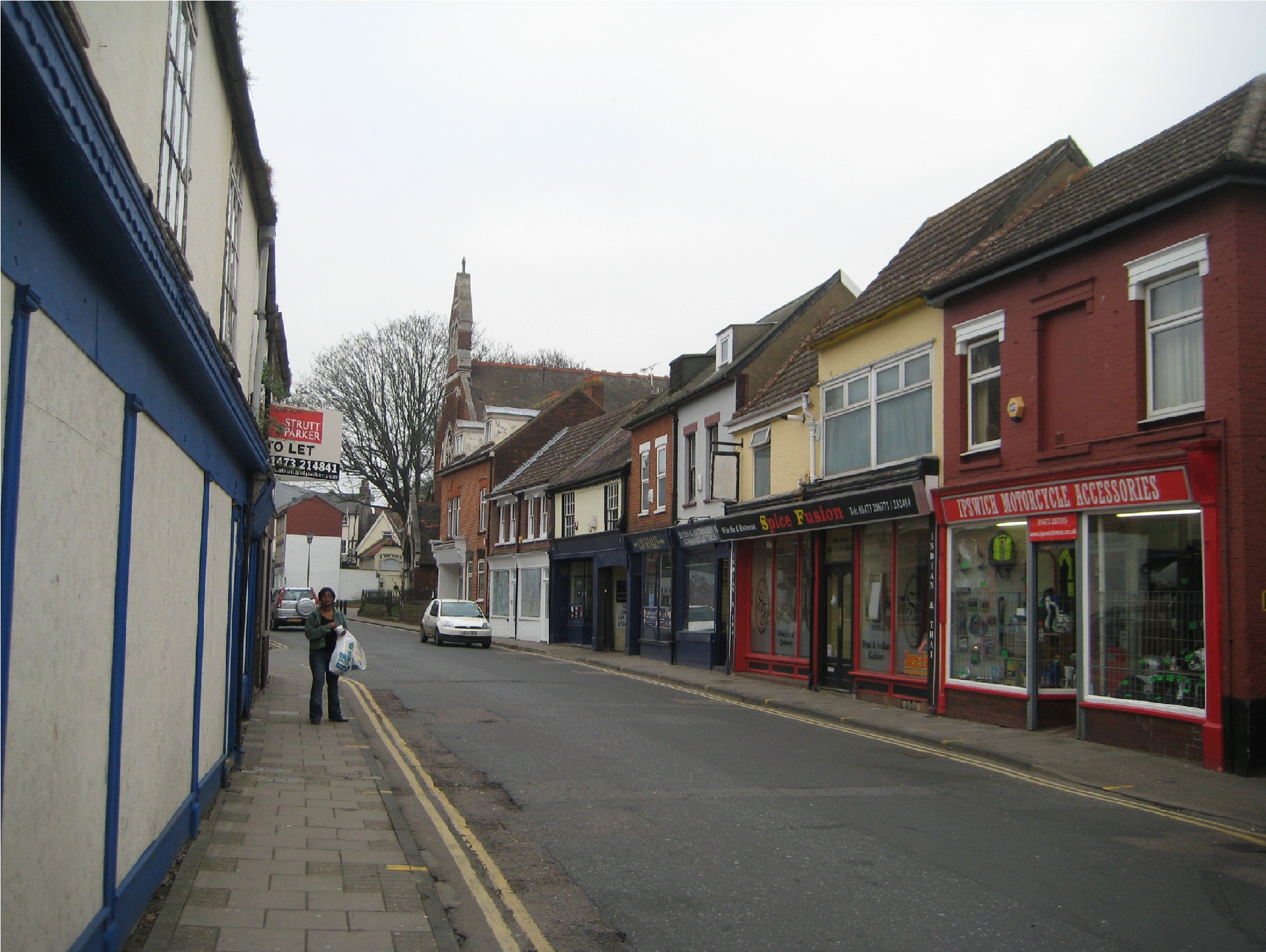
One afternoon, while I was cycling home, I stopped at St Michael’s to take photos of the burnt-out building. Just before I reached the church I passed through Black Friars Court – a space between some ugly housing where some of the remains of the 13th century Black Friars church and friary buildings are situated. As I stood in front of St Michaels snapping away, it struck me that this building was facing the same fate as Blackfriars; vandals had brought down both, although in St Michael’s case not under instructions from Henry VIII. The Church of St Michael was surely not to be fixed up and refurbished, at least not to what it used to resemble. Its more likely destiny now is to be flattened to make space for new buildings. Goodness knows this area of the town could do with some development, but it’s also sad to see the former hub of a community, where so much was celebrated and cherished for so many years, demolished. It’s even a little sadder than watching it slowly crumble as an empty building.









 ipswichhistory
