PURITAN IPSWICH: FROM RESISTANCE TO RESTORATION

You may remember learning about the Puritans from your school days – they were the killjoys that cancelled Christmas and closed theatres in 17th century England. As it happens, there was much more to them than this, but allow me to provide a similarly inadequate sketch of who they were, to put you in the picture before we jump in to their importance in Ipswich. The Puritans were a religious movement that grew out of those that felt that the church during the reign of Queen Elizabeth I (r.1558-1603) was not Protestant enough; they felt that the reformation that had begun under Henry VIII, after his break from Rome, needed to be extended so that all forms of ritual and anything that came between the individual and God were removed. This is why they disliked statues of saints and stained glass windows in churches for example.

Ipswich Context

Ipswich was “a Puritan stronghold in a county that was noted for its opposition to Roman Catholicism and High Church Anglicanism” according to Robert Malster. This was predominantly due to two factors: first, Ipswich’s geographical location as a port town on the east coast of England made it an ideal place to smuggle reformation texts into the country. Indeed, in the early years of the reformation many books were brought into Ipswich by boat, hidden in casks, spreading ideas from continental Europe. Second, Ipswich already had a long history as a place of trade by the beginning of the 17th century. As puritanism tended to flourish in the merchant classes it is perhaps not surprising that it was strongly embraced in Ipswich.

Ipswich was so renowned as a hotbed for resistance that a court play of the period called The City Match describes a character as being “inspired from Ipswich” when she models her sweetmeats into the forms of people from Actes and Monumentes (John Foxe’s famous book that describes protestant martyrs). This tells us two things: Ipswich was nationally renowned for its nonconformist Puritan views, and the Tudors enjoyed playing with their food. England was primed for alphabetti spaghetti, but would have to wait some three hundred years for its common adoption. An England controlled by Puritan reformers was a prospect much closer to hand.

Watch Ward

During the reign of Elizabeth I, the Ipswich Corporation had begun appointing its own town lecturer/preacher. A succession of Puritan town preachers, who outlined their views on how the reformation in England should develop, followed. Samuel Ward was the most enduring and influential of these town lecturers. He was appointed in 1605 at the age of 28 and served the town in this capacity until his death in 1640. Ward, who became known in the town as ‘Watch Ward’, was a successful and popular appointment – he was elected town lecturer for life after only two years in post and his wages continued to rise throughout his time in this position.

Samuel Ward

While very popular in Ipswich, Ward was never too far from controversy in the wider nation. Ward preached against set forms of prayer and in 1621 published caricatures of the (Catholic) court of Spain – normally this would have been viewed as patriotic, but it came at just the wrong moment, as King James was then negotiating with the Spanish over the marriage of his son and after a complaint by the Spanish ambassador Ward was thrown into prison. Ward humbly petitioned the king and was soon released, only to be prosecuted again a year later for nonconformity. Somehow, yet again, Ward escaped unscathed with the final judgement in the matter finding him to be “not altogether blameless, but a man to be won easily by fair dealing.” Clearly, if nothing else, Ward was a man capable of getting out of the stickiest of situations.

Punishment

Ward may have been granted reprieves for his outspoken views, but others were less fortunate. The pamphleteer William Prynne wrote and published Newes from Ipswich, which attacked those higher up in the church of “detestable practices” including the removal of “orthodox and sincere preachers” and “ushering in popery.” Although Prynne had published the work under the name “Mathew White” he was discovered and, having already lost his ears for publishing a previous dissenting text, this time he was sentenced to have the roots of his ears removed, to be branded on both cheeks with the letters “S.L.” for “Seditious Libeller” and to be imprisoned for life.

Civil War

When it came to the civil wars of the 1640s Puritan Ipswich, unsurprisingly, backed parliament in its fight against the Royalists. Indeed, according to Twinch “Historians agree that in no other shire was support for parliament more widespread than in Suffolk, and there were few towns in England where the corporation was more thoroughly sympathetic to parliament than in Ipswich.” This can be largely attributed to its reforming, puritan fervour. Fortunately for the townspeople, military action didn’t come to Ipswich. However, it is a sign of how trusted the community was in its support of parliament’s cause that England’s eastern supply of gun powder, and much of its shot, was moved from Cambridge to Ipswich during the conflict as a measure to increase its security.

Charles I is executed

Although the Puritan base of support for parliament was strong in Ipswich, it would be unfair to say that all, even of a Puritan bent, supported everything that parliament did. Nowhere is this more apparent than in the decision to execute Charles I in 1649 after his defeat by the parliamentary forces. It is hard for us to grasp just how extraordinary this event must have been for people living in England at the time – most people saw the king as ordained to rule by God; for this man to be executed by his subjects was unprecedented and for many incredibly unsettling. A much quoted phrase of the time, all these centuries later, still sums it up best “the world turned upside down”.

The world turned upside down – a much quoted phrase after the execution of the king

In Ipswich, Nathaniel Bacon, the well-respected town Recorder, laid down his pen in sadness upon hearing the news of Charles I’s execution. Bacon concluded his records by stating ‘I have summed up the affairs of the government of this town of Ippeswiche under the bayliffes and whoe are happie in this, that God hathe established their seate more sure than the throne of kings.’

Soon Ipswich’s Puritan rulers found themselves freed to put their tenets into full practice. On the Sabbath day there was to be “no sporting or playing, […] no unnecessary rowing in boats, no bathing or washing in the river, no leaping nor running not sporting with horses” according to Redstone. Despite lists like this giving the Puritans a reputation as killjoys, they also did plenty of good especially in creating an environment in which learning flourished. Eager to spread the word of God to ordinary people, the Puritans opened public libraries and reorganised the Grammar School and Christ’s Hospital in Ipswich.

Restoration

Those, like Nathaniel Bacon, who were sad to hear of the execution of Charles I, would not have to wait too long for the re-establishment of the monarchy. Oliver Cromwell died in 1658. After a failed attempt by his son, Richard, to command the confidence of the army and continue the office of Lord Protector, internal divisions within the Republican Party led to his resignation. In 1660 Charles II was invited to return to Britain as king in what is now commonly known as the Restoration.

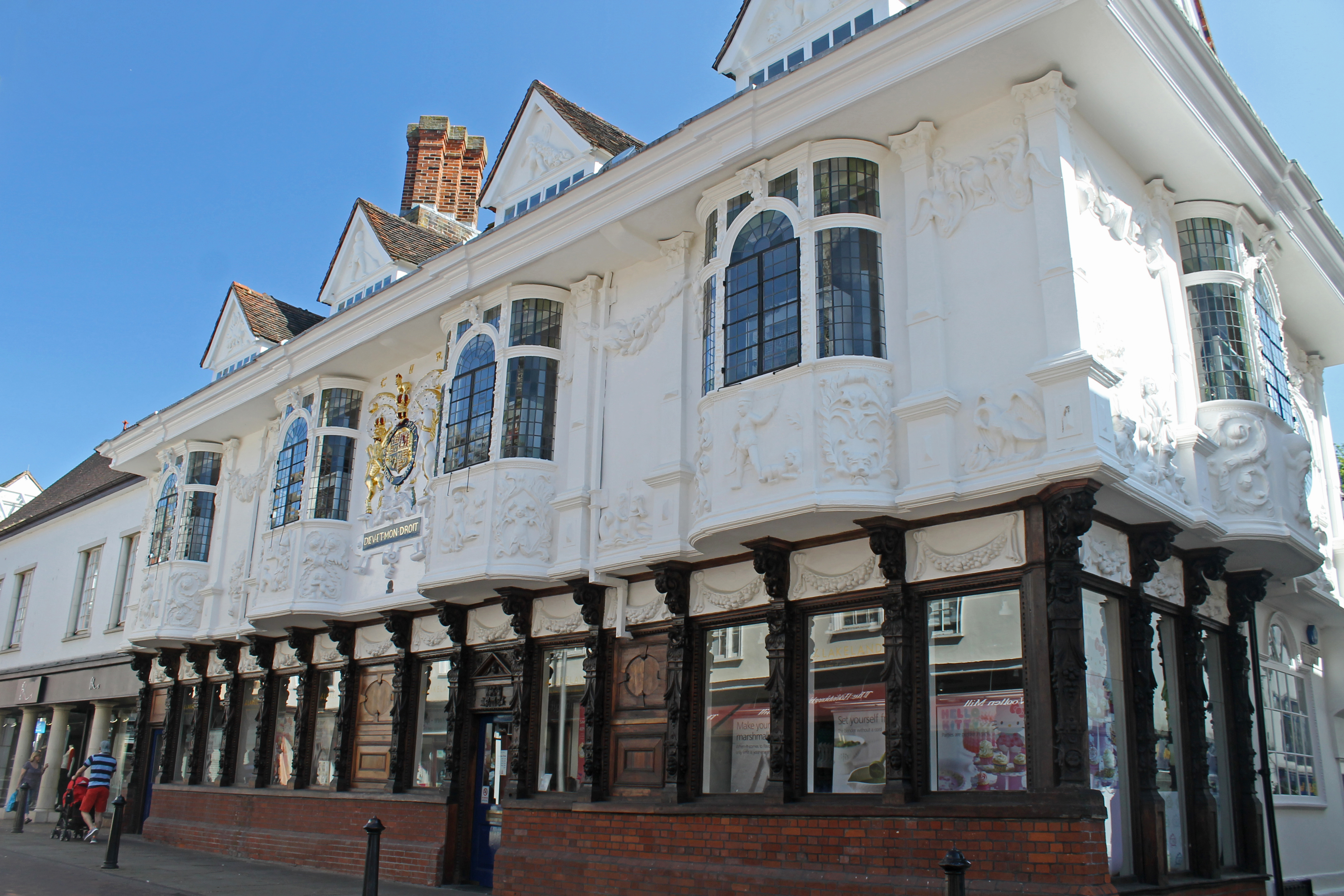
Ancient House, Ipswich
Ancient House

There were celebrations around the country, even in Puritan strong-holds like Ipswich. The most notable surviving relic of the monarchy’s restoration in Ipswich is to be found adorning the front of one of the town’s best known buildings, Ancient House. The Royal Arms of Charles II were placed there by the Sparrow family at the time of the Restoration. The Sparrows were long-time supporters of Charles II and even went on to claim they had hidden him in the house during the Civil War.

An interesting footnote

Samuel Ward’s brother, Nathaniel, travelled to New England to take up residency in Ipswich, Massachusetts. While there he wrote the first code of laws in North America called the Body of Liberties, which was adopted by the Massachusetts General Court in 1641. Some have argued that this work began the American tradition of codified liberties that would eventually lead to the United States Constitution.

Bibliography

Malster, Robert, A History of Ipswich, Phillimore & Co Ltd, 2000

Malster, Robert, Ipswich, an A to Z of Local History, Wharncliffe Books, 2005

Redstone, Lillian, Ipswich Through the Ages, East Anglian Magazine Ltd, 1948, republished 1969

Twinch, Carol, The History of Ipswich, The Breendon Books Publishing Company Limited, 2008

Image of Samuel Ward reproduced with kind permission of Colchester and Ipswich Museum Service, Ipswich Borough Council collection

IPSWICH THROUGH TIME

Hi everyone,

You may have noticed that this blog has been relatively quiet the past few months. The reason for the lack of posts is that I have been working hard in my free time to put together my first ever local history book about Ipswich.

The book is a series of ninety photographic comparisons that contrasts Victorian and Edwardian Ipswich with the modern town. If you are interested you can order it from the publishers directly from here:

I am happy to announce that Ipswich Through Time will be available from 15th February 2015. I am also having a book launch at the Ipswich branch of Waterstones on 7th March at 1pm – please come along if you can make it!

I hope to get back to writing some more ipswichhistory blog posts soon

Best wishes,

Caleb

Ipswich TT event poster

WOLSEY’S GATE

When you walk through Westminster and admire the impressive white stone that comprises the Palace of Whitehall, there’s a good chance part of what you’re looking at was supposed to be a Tudor college in Ipswich.

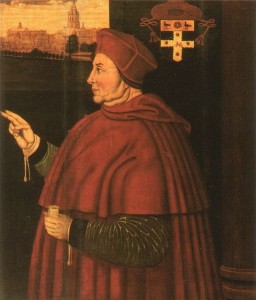
Cardinal Wolsey was a powerful man in the 1520s – in fact, to be perfectly honest, he was probably the most influential man in England, aside from the king. Henry VIII had delegated much of state business to Wolsey, to the point where he administered both home and foreign affairs. This was all rather incredible considering Wolsey’s origins which, while not being destitute, were still relatively humble.

Cardinal Wolsey
Cardinal Wolsey

Born the son of a successful business man in Ipswich, Thomas Wolsey very probably studied at a local grammar school, before he enrolled at Magdalen College, Oxford. Wolsey’s glittering career began when he was ordained in 1498 and then became a parish priest in Somerset. Following this initial post he became Chaplain to the Archbishop of Canterbury, then Chaplain to Henry VII, and eventually served as Lord Chancellor to Henry VIII.

To put Wolsey’s importance into some kind of context it’s worth noting that he was responsible for organising the ‘Field of the cloth of Gold’ in 1520. This was a meeting of the powers of Europe, seeking to prevent future wars between Christian countries, rather like some kind of 16th century version of a United Nations meeting.

Wolsey was definitely one for building; during his years of power he spent much of his wealth on the construction of impressive buildings such as York Palace in Whitehall and Hampton Court. He also established Cardinal College, Oxford (now Christ Church College). To this institution he wished to add some fifteen feeder colleges in diocese around England, the main one was to be in Ipswich, his hometown.

Wolsey's gate 2
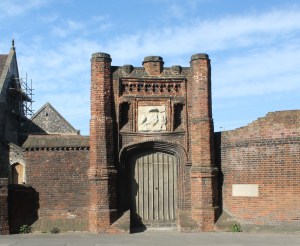
Wolsey’s Gate in Ipswich

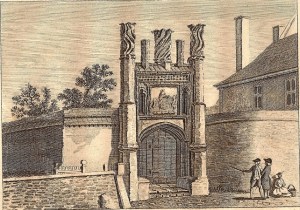
The college in Ipswich was to be built upon the site of the Priory of SS Peter and Paul and to this end the priory was duly dissolved; providing both space and funds toward the building of Wolsey’s proposed school. Building of the college began including the now cherished ‘Wolsey’s Gate’ that was only ever supposed to be a small entrance for people arriving by water (Malster, Robert, Ipswich an A to Z of Local History, Wharncliffe Books, 2005).

In the meantime, before the building work was finished, pupils had started their study at the institution. A letter from the master of the school attached to the college survives, expressing the thanks of the school and the people of Ipswich, including examples of some of the handwriting of the boys in attendance.

Things were not destined to stay so rosy for Wolsey; the rise of Anne Boleyn saw his downfall. Anne took serious offence when Cardinal Wolsey failed to secure a quick annulment of Henry’s first marriage to Catherine of Aragon. Anne persuaded the king that Wolsey was deliberately putting a halt on the process. As a result, Wolsey was stripped of his office and the impressive buildings he had erected.

The downfall of Wolsey spelled the end for his grand plans for the name of his Cardinal College in Oxford, and the building itself of his main feeder college in Ipswich.

Wolsey's Gate 1
Wolsey’s Gate – originally designed to be the river entrance to the college

Now all that remains is Wolsey’s Gate; the last small fragment of Wolsey’s aspirations for his home town. In 1532, all the ‘timber, lead, wainscot and white stone of divers kind’ that remained in Ipswich, waiting to be used for the construction of the college, were packed up and taken by sea from Ipswich to the Galley Key by London Tower, ‘to be used for the king’s buildings at Westminster’ (Redstone, Lilian J., Ipswich Through the Ages, East Anglian Magazine Ltd, 1948). In a cruel turn of fortune, the very construction materials from Wolsey’s buildings in Ipswich were (now repossessed by Henry VIII) used to expand another of Wolsey’s projects in London – York Palace in Whitehall – that now belonged to the king.

As for Wolsey, he was granted a last minute reprieve from Henry and allowed to remain Archbishop of York. However, he was later accused of treason and summoned back to London to answer the charge. On the journey to the capital Wolsey fell ill at Leicester and subsequently died on 29th November, 1530.

An interesting footnote: Just as Wolsey had erected impressive buildings as residencies during his life, he had similar plans for his remains; he had planned a magnificent tomb in Windsor complete with a carved black sarcophagus. In the event of his unforeseen death in Leicester, he was buried in the Abbey of St. Mary of the Meadows. His grave is now unmarked and unknown. The black sarcophagus had to wait a further 275 years to be used. It now lies in the crypt of St. Paul’s Cathedral and contains the remains of another great Briton, Horatio Nelson.

CHRISTMAS CRACKER

It’s hard to define exactly what the Christmas spirit is; family and community celebration perhaps? Or tinsel, carols and mince pies? Whatever it is, the Ipswich Transport Museum Christmas cracker event has it in spades, and that is where I found myself on the afternoon of Saturday 7th December.

IMG_3827As I entered the museum I was greeted by the sound of a brass band playing Joy to the World, which is always a good way to start getting you into the aforementioned Spirit.

As I paid my admission I noticed a child receiving five old English pennies to spend in the museum, this is a yearly tradition I later discovered, allowing the children to spend their 5d on treats and attractions – from a visit to Santa’s grotto to rides on vintage vehicles.

 I began my perusing of the Transport Museum displays to the background sound of carols supplied by the brass band. This was great, providing the warm sensation of a Salvation Army band without the cold, rushed, last-minute Christmas shopping induced panic, that usually accompanies hearing them in the street outside Debenhams. Instead, I could take my time examining the huge amounts of transportation devices on display, from the motorised to the pedal powered. I looked around and learned a little about Ipswich Engineering, and then I looked up and saw bicycles, lots of bicycles, all hanging in a central line from the rafters of the building.IMG_3856

 Established in 1965, Ipswich Transport Museum is the home of all things mechanical made and used in Ipswich over its history, and with companies such as Ransomes and Rapier having made Ipswich their base over the years it turns out this is quite a lot.

The museum is impressively run entirely by volunteers. One such volunteer is John Griffiths, who I found standing next to a miniature railway village, complete with train chuffing smoke, endlessly circling its rails, as if finding it impossible to locate an appropriate spot to stop. We got talking and he enthusiastically began to tell me about the Transport Museum’s lateIMG_3858st major project – the affectionately named ‘Operation Firewood’ – restoring a 1890s tram, which was until recently being used as someone’s shed, back to its former glory.

John is a man with an encyclopaedic knowledge of horse-drawn and electric trams. He could, and did, speak with interest on the subject for half an hour, but realising the limited time I had before the museum closed, I extricated myself from the conversation in order to see what else the museum had to offer.

One of the things Children could spend theirIMG_3835 5d on was a Clementine from a mobile grocery vehicle, which was today being manned by one of my colleagues from the Colchester and Ipswich Museum Service. As I walked over to meet her, Brian, another volunteer, appeared and my colleague introduced us to each other. Upon hearing my connection to the museum service, he kindly offered to take me on an interesting behind the scenes tour of the museum; viewing the stores and hearing plans for future development. When we walked into the museum office Brian was keen to point out their computerised documentation system, which they had created from scratch themselves, and I was yet again impressed with the level of commitment the museum elicited from its volunteers.

 It was time to fully embrace the Christmas transport spirit and experience the delights of a vintage vehicle in motion. I plumped for a bright red 1960s fire engine. A young boy sat in the driver’s passenger seat in IMG_3841front of me taking every opportunity to ring the engine’s bell as loudly as he could, clearly enjoying the rare opportunity to create as much noise as possible whilst being praised for doing so by adults.

I left the hanger feeling pretty Christmassy and very impressed with the friendly and welcoming volunteer army that made the event, and the museum itself for that matter, possible.

So the Transport Museum is great. It goes without saying, but I thoroughly recommend a visit. Oh, and one last thing. MERRY CHRISTMAS!

SUTTON HOO

Most of Europe was busy preparing itself for war in 1939, building weapons, training soldiers, while some desperately brokered for peace. Edith Pretty meanwhile, decided this would be a good time to dig up her back garden. Pretty had become interested in spiritualism since the recent death of her husband and many of her spiritualist friends began to speak of shadowy figures walking around the mounds in the grounds of her estate. Naturally, this piqued Pretty’s interest and soon she had convinced the Ipswich Museum amateur archaeologist Basil Brown to start work on the site.

*

‘Excuse me’ I said, winding down the window of my ever trustworthy Ford KA.

‘Is it okay if I park anywhere around here?’ The farmer looked at me nonplussed in silence for a couple of seconds.

‘You know, to get out and look around’ I added. I was on my way to Sutton Hoo, but appeared to have ended up in a cabbage farm.

 ‘You carn’t stop around ‘ere’ said the farmer indefatigably, shooting me a look that seemed to say ‘No, this is a forecourt with dangerous threshing machinery and oversized tractors moving huge payloads of cabbages, you stupid townie, you’re in the way’.

‘Oh’ I said ‘Do you happen to know…’

‘If you want Sutton Hoo you need to git down that path along that way and go back ‘bout quarter mile, then take a left’ Said the farmer cutting in and beginning to look irritated. ‘This is a workin’ farm, you can’t stop ‘ere’.

‘Thank you very much’ I said, ‘I’ll get out of your way then’ The farmer said nothing, but continued to stare at me.

‘Okay, thanks again’ I said with a nervous smile. I turned the car around, narrowly avoiding a cabbage, and followed the track back the way I had come, safe in the knowledge that my famous sense of direction was as intact as ever.

I paid my admission (£7.15) and received my national trust sticker. As I was just about to leave the admissions office the lady who served me called out.

‘Most people start with the visitors centre, it’s just across the way. That will explain things a bit better for you before you head on over to the mounds’.

Carole obviously wasn’t an ipswichhistory blog subscriber; I knew what I was doing. I set off for the mounds straight away.

*

In the spring and summer of 1939 Basil Brown had begun work on site at Mound 1, with the help of Pretty’s gardener. He was soon followed by a more professional team of archaeologists including Charles Phillips, who took over and extended the excavations, which included the unearthing of the remains of a 90 foot ship burial. The team continued to work until World War Two got into full swing, where upon, the valuable findings from the burial site were put into secure storage in the London Underground. The archaeologists departed also, probably in search of somewhere a little less vulnerable to Nazi bombing, to write up their findings to be published in 1940.

 What had been found was staggering to the archaeologists, it completely changed perceptions of what ‘Dark Age’ Britons were capable of creating. As life began to return to normal in post-war Europe, historians returned to Sutton Hoo, first in 1965 and then repeatedly from the 1980s to the present day, uncovering more burial sites (including 17 confirmed mounds) and piecing together a better picture of what was going on in this confusing mass of mounds.

 Many of the finds at Sutton Hoo show just how interconnected Europe was during the time of early Angles. Mound 1, for example, held weaponry artefacts with strong stylistic links to Viking Scandinavia, but also included coins minted in France and two silver spoons, that were Christian in origin, likely from as far away as Byzantium (modern day Istanbul). One of the things you come away from Sutton Hoo with is a sense that 7th century Angles were far more connected with parts of costal Europe than they were with the landlocked parts of their own island.

*

The mounds were a good five minute walk from reception and when I arrived I found myself completely alone. There was no real wow moment to speak of, just a lot of large mounds of earth with clumps of gorse cover and a nearby pig farm that leaked faint piggish smells over the burial grounds. After this initial sense of disappointment however, the place began to grow on me. It felt quite isolated bearing in mind it was a place surrounded by farms and Pretty’s heritage site of a home. I began to think about just what was found under this place I was walking over, and after a while, I did begin to feel like I was somewhere quite special.

I made my way around the site and eventually stopped at the viewing platform. After another five minutes of staring at mounds of soil, my interest had peaked and I realised that this place really was unique, as there was nowhere else I could think of that would charge £7.15 to look at mini soil hills. And so, I decided to go in search of greater value from my admission fee and take a walk along a different footpath back to the visitors centre.

20 minutes down the track and I was lost. It slowly dawned on me that I must have absentmindedly missed a right turning somewhere along the way. I pressed on for a while hoping that another path would emerge sooner or later, but later came and went and still there was nothing but closely set trees to my right hand side. I closed my visitors map and began to squeeze my way through the trees and bracken. Somehow 5 minutes later I re-emerged on the other side of the trees exactly where I wanted to be, by the visitors centre.

 I walked forward towards the door and noticed a lady checking people’s national trust stickers on the way in. I looked down to find that mine had vanished, probably torn off by a branch a few minutes previously.

 Carole from reception had been right – you should always start with the visitors centre when you visit Sutton Hoo. Unless, of course, you feel competent enough to look after a sticker for an hour or so.

*

 We don’t know for sure who the incredible treasures in mound 1 belonged to, but the evidence available does seem to point to Raedwald the 7th century king of East Anglia. First, the age of the coins found within his burial appear to fit the correct time. Secondly, the Venerable Bede’s writing in the 8th century describes Raedwald as a king that converted to Christianity, but retained his heathen beliefs, which is echoed in the findings of both Viking ritual and Silver baptismal spoons in the ship burial chamber. If it wasn’t Raedwald, it was certainly someone with his level of incredible wealth and respect.

 *

Luckily, I found another National Trust sticker lying by a nearby hedge, quickly picked it up and held it to my coat while no one was looking. Then, sticker in place, I walked into the visitors centre like 007 sneaking past the inept guards at a villain’s lair.

Actually, the people at the visitors centre were really nice, and began talking interestingly to me about Sutton Hoo. There was an introductory short film about the people that lived in the area around the 7th Century and interesting exhibits and displays of replica finds (the originals were donated to the British Museum by Edith Pretty). I rounded things off by walking into the newly installed reconstruction of Raedwald’s burial chamber complete with reconstructions of the artefacts found within.

Walking out of the visitors centre and back to the KA, I began thinking it was a shame that the original relics weren’t on display here instead of in London, then maybe more people would want to visit such an interesting place. These things are all relative though I suppose. I expect the 7th century Angles who spent huge energies dragging a longboat over a mile from the river Deben to the burial site, and presumably even longer burying it under a mound of earth, would be a little more put out that the treasures weren’t where they left them.

This slideshow requires JavaScript.

NEW DESIGN FOR A NEW YEAR

Happy New Year everyone! This is just a post to say thank you so much to Kelly Wadsworth for creating a new amazing header for the blog from scratch!

Kelly is a fantastic graphic designer and if you would like to see more of her brilliant work then you should check out her blog and online portfolio of work here: http://www.kellygraphicdesign.blogspot.co.uk/

New post to hopefully follow soon!

TIMELINE

https://prezi.com/ccvsx7eq2mvv/ipswichhistory-timeline/

This is my first attempt at a prezi – so sorry if it’s a bit amateur. You can click on any of the pictures, clips and text if you want to zoom in on them as well as moving through the presentation using the arrow keys. Hope it’s interesting.

MUSEUM MUSING

I decided to go to Ipswich Museum for some inspiration for my next blog post, especially since I hadn’t been there for years, but while I was walking around I thought it might be fun to write my own little review/guide to the place. What follows is a selection of highlights from my walk around the museum.

Ipswich Museum

Victorian Natural History Gallery

Rosie the Rhino

The first thing you see when you walk through the doors into the museum is the woolly mammoth and in my opinion that’s exactly what you want to see when you walk into a museum. The whole of this first hall is filled with taxidermy – every animal from mouse to monkey to lion, but it’s the mammoth and its sheer size that grabs you first. I walked over and looked up at its hairy face and could instantly remember coming to the museum as a child and wanting to jump over the barrier and climb up on to its back, the same went for the rhino and the giraffe. Standing there, surrounded by stuffed animals of every variety with blank eyes, I found that I still wanted to. I shot a look over my shoulder at the hovering security guard, but he looked like he’d had a long day and I didn’t think it would be fair to put him through the ordeal of tugging a 24 year old man-child off a prehistoric mammal replica, and anyway, I still wanted to see the rest of the museum.

Here are a couple of interesting facts about the Natural History Gallery to keep you going:

1). The gorillas on display known as the Du Chaillu’s Gorillas were the first ever seen in Britain.

2). The rhino (known to visitors as ‘Rosie’) arrived at Ipswich Museum in 1907 and was traded with the British Museum for a pig.

Ipswich Museum’s Victorian Natural History Gallery

Unfortunately, Rosie had her horn stolen in July 2010 and the two men seen driving off from the scene of the crime were never caught. Happily though, the horn has been replaced with a replica and visitors have been leaving messages of congratulations to the curators and Rosie in a comments book next to her ever since, which is very sweet.

Anglo Saxon and Early Ipswich

I walked through a glass door into another part of the museum that houses lots of original artefacts and replicas from Suton Hoo that tell the early story of Ipswich complete with Anglo Saxon dressing-up clothes and the life size humanish looking models you see in all regional museums. One was holding a tool over a piece of metal and looked like he’d been trying for a long time to decide whether or not to hit it, another was of a woman who seemed to be in a similar quandary over whether she should continue with her weaving.

I began to look around and was drawn over to a display inviting me to create an Anglo Saxon name for myself, all you had to do was spin two discs – one with prefixes and another with suffixes – and hey presto! Anglo Saxon name! I spun the wheels and was rewarded with Fri-Wyn or ‘Free-Joy’ in the modern English translation.

I was just getting interested in a display explaining the roots of early Ipswich when the door to the room swung open again and two ex-pupils from the school I work at walked in.

“Oh it’s you” said the first one.

“You ust to work at Westbourne didn’t-cha?” said the second.

“Hello, yes I still do” I said

“It’s a dump” said one of them very matter-of-factly

“How’s my brother doin’?” asked the other

The conversation kept going. I won’t bore you with the whole thing, but the best thing to come out of it was a mildly humorous moment when I asked one of them what they were doing at college now and thought they said geography when they had actually said photography. By the time I had managed to escape, one of the security men arrived ringing a bell and announced it was closing time and that I needed to leave the museum. The rest of the rooms would have to wait for another visit.

Bones and Fossils Gallery

I left myself a lot longer before closing-time

Ipswich Museum’s Geology Gallery

when I next returned to the museum. I started in the long rectangular room that houses the museum’s considerable collection of bones and fossils. I began prowling up and down the cases looking for something that took my interest. Along one wall were some heavy Victorian display cases displaying the skeletons of various animals as they would have been arranged in life (you really can’t move for dead animals in Ipswich Museum). Apart from bones and fossils this room also devotes itself to telling the story of Suffolk’s geological past over the previous millennia, unfortunately, although I really tried I just couldn’t get passionate about changes in soil composition so I thought it was time to move on.

The main things that I took away from this room were that thousands of years ago some elephants used to be a lot bigger than they are currently and that they had straight tusks. The other was that lions used to be a common enough animal to find in the wild around Ipswich about 210,000 years ago, where, according to an archaeological dig under Ipswich’s Stoke railway tunnel, they were busy chasing red deer.

The Bird Room

You could never accuse Ipswich Museum of being obtuse with their labelling of rooms, the Bird Room is, as advertised, a room with lots of birds in it. I’m not really sure what else to tell you about the bird room, apart from to say it is impressive to see so many different breeds of bird from all over England and Scotland all in one place and it appeals to all ages if the

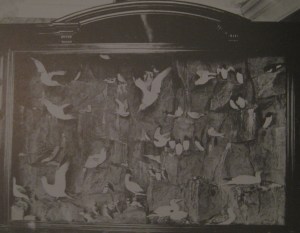
A photograph of the Bass Rock Case taken soon after its installation

enthusiastic French gentleman and his granddaughter were anything to go by. To be honest, this wasn’t my favourite part of the museum; all the dead animals with their vacant faces and fake eyeballs were beginning to get to me by this point, so I quickly made for the exit. Before I reached it however, I came to the pièce de résistance of the room – the Bass Rock Case. This full size diorama, that includes fifty-two seabirds, aims to recreate a scene from the Bass Rock gannet colony off the coast of Scotland complete with eggs, seaweed and bird poo running down the cliff face. The scene was created thanks to the legacy left by Lord John Harvey in 1902, this struck me as quite an unusual thing to request in your last will and testament, but each to their own.

Egyptian Gallery

I walked into the Egyptian Gallery, which didn’t exist when I used to visit as a child. I was pleasantly surprised at just how good this new section (opened in 2010) was. For a start there are lots of genuinely impressive artefacts on loan from the British Museum on display including some large statues of Various Egyptian gods, some of which are around 4,000 years old. In fact, Ipswich Museum already had an impressive stock of items from Ancient Egypt donated in the early 20th century by friends of the Museum who were keen to prevent grave robbers from getting their hands on them for profit.

Egyptian Gallery

Some of the more impressive objects are kept within a central chamber inside the gallery that is accessible by a doorway for adults and a giant mouse hole in the wall for children to crawl through. There were a lot of families with small children around me at this point and the kids were going crazy for the Egyptian history, when they saw the mouse hole it sent them over the edge and for a good ten minutes it was hard to move for running, screaming, crawling children.

After the families had departed I went into the chamber too (through the door not the mouse hole, although I was tempted). Inside it was really interesting; the curators had thoughtfully placed mirrors at the correct angles to allow you to see inside gold coated masks and sarcophaguses. Seeing the stained cloth inside of the masks particularly forced me to think of these objects not just as pieces of intricate, beautiful art work, but also as the shelters of human remains that they were. It was a bit spooky, but also very fascinating. The other thing that stood out to me was just how many things the Egyptians used to mummify, not just people and cats, but birds and crocodiles, pretty much anything they could get their hands on it seemed.

I walked out of the Egyptian Gallery,

Underfloor display in Egyptian Gallery

looped my way around the balcony of the Natural History Gallery looking down at all the rigid animals below and made my way down the main staircase back to the reception. It was time to go, there was still more to see but that’s plenty enough for this post, and I think I’ve taken up enough of your time already. Anyway, if you’re still interested by this point what are you doing? You’ve clearly got enough time to go and make a visit yourself.

COUNTY TOWN

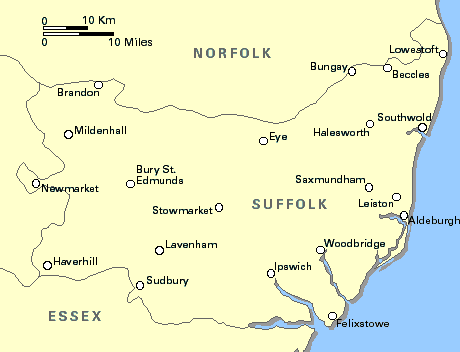
It’s been a long time since I wrote my last post and it took me a while to get back into the swing of things, particularly when coming to chose a subject to write about. whilst casting about for a topic it struck me driving past a road sign welcoming me to ‘Ipswich the County Town of Suffolk’, that I had no idea why Ipswich, of all Suffolk Towns, had become the County’s top dog.

There have been well established settlements in Suffolk for longer than nearly anywhere else in the country and yet it remains almost stubbornly non-metropolitan. While Suffolk has largely clung to its rural roots, there have been small pockets of urbanisation that have vied for supremacy within the county for centuries. Why it is that Ipswich emerged and remained the most dominant of these and became the County Town is the subject of what follows.

Ipswich’s awkward position in the south-east corner of the county has caused some difficulties over the centuries

The location of Ipswich has thrown up several road blocks for the town over the centuries and could well have seen Ipswich’s importance diminish quite considerably if history had taken any of several slight deviations. This was particularly true when it came to Ipswich’s role in the Shire Moots/County Courts since the earliest developments of the country’s parliament. This was important because considerable power followed the judges who sat in them.

During the 13th and 14th centuries Ipswich played host to the early Shire Moots where the Kings judges, that did not then sit in one place but perpetually moved around to various sites, pronounced their verdicts. They did this in shirehouses, although the knowledge of the exact placement of Ipswich’s original shirehouse has been long since lost. For some reason the inhabitant

s of Ipswich allowed their shirehouse to rot away and thus when combined with Ipswich’s awkward location, the king’s judges decided to make Bury St. Edmunds their new stop off point for the courtly affairs of Suffolk upon their circuit between Cambridge and Thetford.

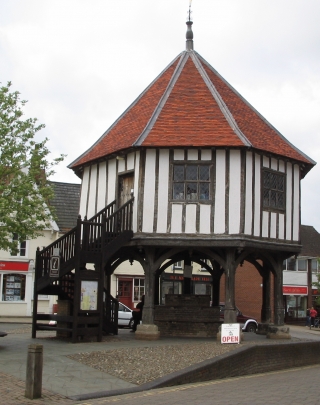
Wymoundham Moot Hall, an example of a 13th century East Anglian meeting place for courtly affairs

Things remained this way until 1698 when Ipswich, led by Sir Samuel Barnardiston its Member of Parliament, secured a grant of £300 from the county towards building a new and up-to-date Sessions House. In fact, even this could not persuade the judges to cover the longer distance to Ipswich and it was only the fear of smallpox in Bury in 1740 that drove them to the new hall at Ipswich and led to it becoming customary to divide the assizes between the two towns.

Ipswich’s location in the far south-eastern corner of Suffolk has been a drawback in the past, not just in attracting judges to the town but also, perhaps more importantly, in attracting trade. What overcame this problem for Ipswich was the navigability of the river Gipping into the heart of the county. From the middle ages onwards the waterway had been used to transport heavy materials and goods such as wine, salt and stone from the coast further inland, but only after the Navigation Act of 1793 was it opened up to large scale traffic through the spread of canal networks, allowing barges to deliver coal throughout the county as far as Stowmarket. The river routes from Ipswich into the county made it all the more centrally important to the county because there was a lack of good roads in the surrounding area until relatively recent times. This reliance on water transport made Ipswich, near the coast and on the river, an obvious centre of business and communication.

The introduction of railways to Suffolk only served to strengthen the position Ipswich had as a centre for commerce in the county, drawing in more businessmen, labourers and customers from the surrounding smaller settlements. Ipswich market grew as a result and ever since all the villages of south-eastern Suffolk have made Ipswich their centre for shopping, amusement and business.

Ipswich had become a centre for entertainment in the county by the Tudor period, by this time the docks had established Ipswich as a reasonably prosperous place, this was reflected in the high concentration of knights, gentry and wealthy merchants who lived in the town, who in turn made it possible for the development of theatre and dramatic performances that mainly took place in the Moot Hall. At the same time, what we might now consider, less high brow entertainment was becoming available in Ipswich; bear baiting became a regular feature on the Cornhill and players of the cornet and lute walked the streets in the hope of adding to their yearly wage.

The Cock and Pye Inn, which used to play host to one of the county’s favourite forms of entertainment

After the years of Puritan control, when entertainment across the country was for the most part eliminated, (In 1637 the Ipswich bailiffs actually paid the king’s servants not to play in the town) Ipswich once again became a hub for amusement. New theatres including one on Tacket Street were built and horse racing came to Ipswich by the mid 1700s taking place on the nearby heath.

Other sports popular at the time that attracted large audiences to the town included cock fighting, most notably at the aptly named Cock and Pye Inn, which still remains so named today. Ipswich was fortunate to be well endowed with many good Inns and Hotels and remained well visited for entertainment and holidaying well into Victorian times, the author Charles Dickens often staying in the regionally famous White Horse Hotel and writing it into his first novel The Pickwick Papers. All of these attractions helped make Ipswich an obvious place to develop county infrastructure.

Another factor that has made Ipswich central in importance in Suffolk has been its role in caring for the sick of the county. During the 19th century when inoculations against illness became widespread, Ipswich became a hub for such treatment for East Suffolk, so much so that in the early days of small pox inoculation doctors refused to inoculate patients from outlying villages because the large numbers of people crowding into the town threatened an epidemic.

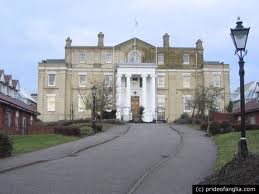
The first purpose-built hospital in Ipswich. Today it still performs a caring role as a care home

The East Suffolk and Ipswich Hospital was opened in 1836 for about 50 in-patients and has continued to expand ever since, spreading to different sites around the town, cementing the role of Ipswich as the principal care provider for a large area of Suffolk.

Ipswich has managed to develop and maintain features that have made it vital to a largely rural backwater county like Suffolk. It has provided a source for entertainment, important trade links from the coast into the heart of the county and secured a prominent role in courtly and administrative affairs over the previous centuries. It has also become a regional base for essential services such as the police and healthcare system in the local area. Through all this it has also dealt with competition from towns such as Bury St. Edmunds and Stowmarket as a provider of goods, resources and other attractions of power to become regarded as of central importance to the region and become the county town of Suffolk.